
Wind turbines should be inspected semi-annually to support safety and performance. A Renewable Energy Inspection examines the condition of key turbine components, including blades, towers, nacelles, fasteners and electrical systems. The checklist can apply to onshore and offshore turbines, with offshore environmental conditions considered in the inspection scope.
Regular inspections help identify developing defects before they affect structural integrity or equipment operation. In Scotland’s renewable energy sector, a consistent inspection process also gives asset teams a clearer basis for maintenance planning and follow-up assessments.
This article explains what wind turbine inspections cover, how checklists account for onshore and offshore conditions, and why inspection frequency matters. It also outlines how renewable energy inspections can include equipment-specific checks, helping readers understand how inspection supports asset condition and operational reliability.
Key Takeaways
- Inspect blades for cracks and erosion, towers for corrosion and structural weakness, and nacelles for wear and alignment issues.
- Use inspection checklists for both onshore and offshore turbines, accounting for offshore environmental conditions.
- Schedule wind turbine inspections semi-annually to support safety and performance, and use findings to guide maintenance priorities.
- Match inspection activities to the technology: renewable assets can require checks of components such as electrical systems, geothermal piping, pumps and heat exchangers.
- Review maintenance records and operational history as part of the inspection, alongside checks that safety protocols and emergency procedures are current.
Wind turbine blade, tower, nacelle, and electrical inspections
A turbine inspection examines structural and mechanical condition alongside electrical function. Checklists can cover onshore and offshore assets, taking offshore environmental conditions into account.
Inspection scope varies by asset type and scale. A residential assessment may consider windows, appliances, and energy consumption, while a commercial or utility-scale inspection focuses on generation equipment and its supporting structures.
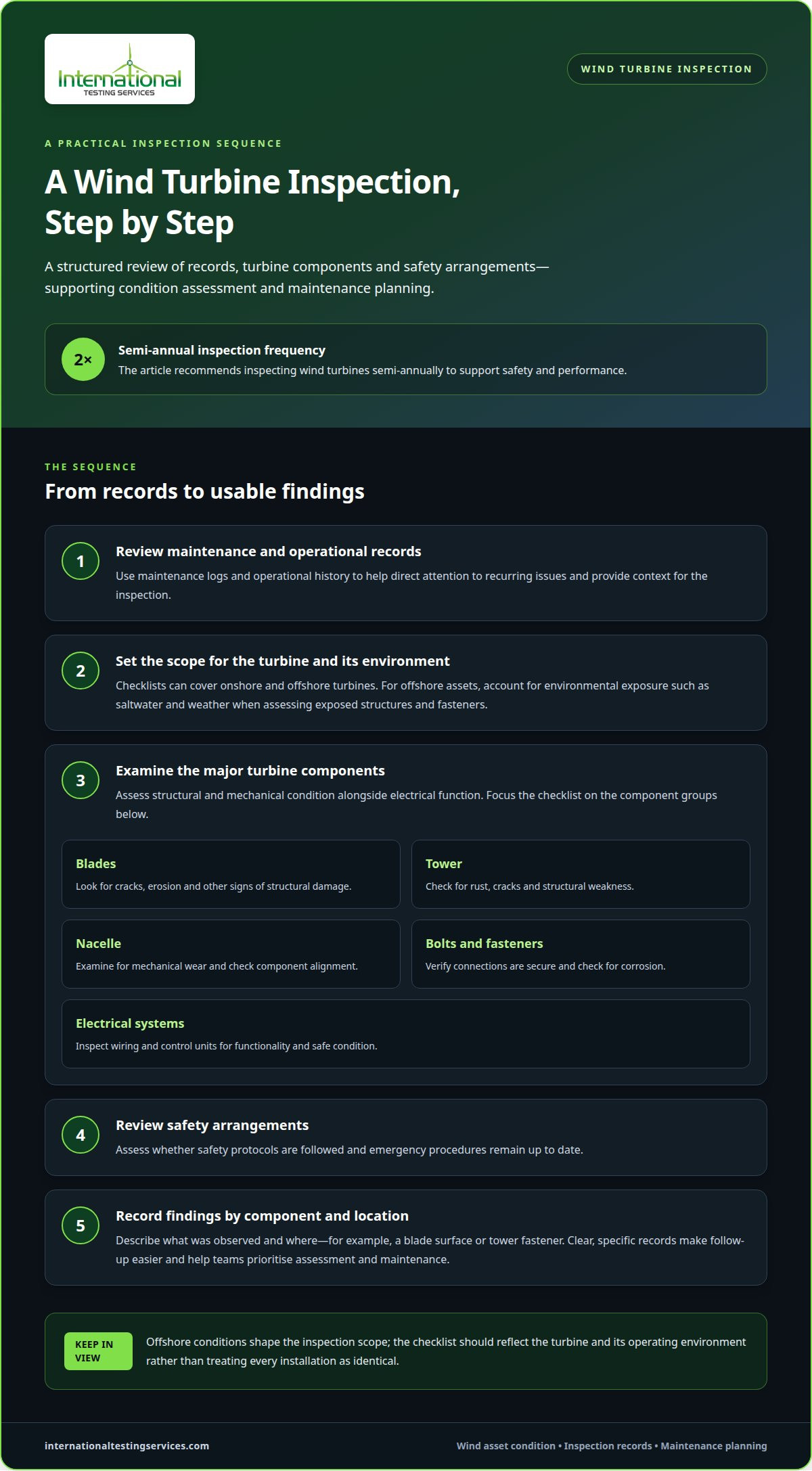
For a wind turbine, inspectors examine each major component for changes that could affect safe operation. A practical checklist includes:
- Blades: Inspect surfaces for cracks, erosion, and other signs of structural damage.
- Tower: Check for rust, cracks, and structural weakness that may affect the tower’s integrity.
- Nacelle: Examine components for mechanical wear and check whether parts remain properly aligned.
- Bolts and fasteners: Verify that connections are secure and free from corrosion.
- Electrical systems: Inspect wiring and control units for functionality and safe condition.
Onshore and offshore checklists address the same component groups, but offshore environmental conditions shape the inspection. Saltwater exposure and weather can contribute to corrosion and surface deterioration, so inspectors should consider these effects when assessing exposed structures and fasteners. The checklist should reflect the turbine and its operating environment, not treat every installation as identical.
Steps in a System Inspection
A system inspection is a structured review of equipment condition, records, and safety arrangements. Maintenance logs and operational history can help direct attention to recurring issues.
Inspectors review maintenance logs and operational records, then examine relevant turbine components against the agreed scope. They also assess whether safety protocols are followed and emergency procedures remain up to date. Recording findings against specific components, such as a blade surface or tower fastener, makes follow-up clearer.
Common Safety Risks and Defects
Common defects include blade cracks and erosion, tower rust or cracks, nacelle wear, corroded fasteners, and electrical-system faults. These findings can indicate deterioration in structural integrity or equipment function.
Loose or corroded connections, damaged wiring, and malfunctioning control units also warrant attention. Offshore exposure can heighten corrosion concerns, while misaligned or worn nacelle components may signal a developing mechanical issue. Recording the defect’s location and component helps teams prioritise assessment and maintenance.
A focused blade review provides a clear record of surface condition. Wind turbine blades should be inspected for structural integrity, including cracks and erosion. Note the location and visible extent of each finding, and describe it specifically enough to support later review. Clear records distinguish an observation from a proposed response, so teams can discuss findings without overstating what a visual check establishes.
Link each recorded concern to the affected blade area and inspection notes instead of relying on a general label. This keeps evidence useful when considering further assessment. Limit the inspection account to what was observed, and make uncertainty clear when visibility or access prevents a confident description. Careful records clarify whether a finding concerns a crack or erosion and what follow-up may be needed.
Benefits of regular renewable energy system inspections
For Scotland’s renewable assets, regular inspections help teams identify deterioration, evaluate equipment condition, and plan maintenance using recorded findings. Reviewing defects alongside maintenance logs and operational records can help distinguish new issues from recurring ones and direct attention to components needing assessment or follow-up.
Early identification can clarify how a defect relates to surrounding equipment. For example, corrosion on a connection can prompt examination of adjacent components and supporting metalwork. A crack recorded in a structural element can be tracked during later inspections. These records give asset managers practical evidence for prioritising maintenance rather than relying on an isolated observation.
Inspection findings also inform maintenance planning. Teams can compare reports, identify recurring concerns, and direct resources towards components showing changes. Operational records add context when system performance shifts, helping focus examination on relevant equipment. This differs from an energy audit, which assesses building energy efficiency. Renewable asset inspections focus on generation equipment and its condition.
For Scottish projects, federal codes are not the applicable framework. Inspection planning should consider relevant UK and Scottish requirements, project specifications, and applicable British or European standards. Scope depends on the technology and work involved, so no single checklist covers every renewable installation.
Inspector qualifications depend on the method, equipment, and defined scope. Personnel need the technical competence to perform the specified examination and interpret its findings. Establish any required certification from applicable project specifications and standards. A building energy audit and an examination of a utility-scale turbine involve different tasks and qualifications.
To identify requirements for a Scottish site, start with project documents and technical specifications. Establish the asset type, examination activity, and relevant British or European standards, then align the inspection scope accordingly. A solar electrical examination and a wind-turbine structural assessment, for example, involve different equipment and criteria.
Inspection records can also help buyers assess an asset’s documented condition. Reports that clearly identify findings and outstanding follow-up support more informed technical discussions. They do not replace a buyer’s wider engineering and commercial assessment, but can show which components need further attention.
- Use documented findings to prioritise maintenance actions.
- Compare inspection records with operating history to identify recurring issues.
- Set the scope against the asset, project specifications, and relevant standards.
For geothermal equipment, follow-up may consider operating symptoms and subsurface conditions. Reduced efficiency, unusual noises, leaks, and inconsistent temperatures are listed as signs of geothermal system failure. Subsurface temperatures and pressures should be monitored to ensure system stability. A duct leakage test can identify cracks or disconnections in HVAC ducts by sealing supply and return registers and pressurising the duct system.
Building-focused energy work is distinct from renewable-asset inspection. An ASHRAE Level I energy audit provides basic information on system age and estimated cost savings. Home energy audit recommendations may include sealing cracks, adding insulation, upgrading appliances, or improving major systems. Sealing leaks, maintaining air filters, and upgrading ventilation systems can contribute to better indoor air quality.
Wind turbine inspection frequency
Wind turbines should be inspected semi-annually to support performance and safety. This interval provides a planned point to assess condition, record changes, and identify maintenance needs. It gives operators a recurring basis for oversight rather than relying only on inspections after faults become apparent.
A calendar interval is a starting point, not a complete inspection plan. Additional checks can be scoped and timed in light of operational records, previous findings, and changes in turbine condition. A defect recorded during one review, for example, can guide targeted follow-up before the next scheduled inspection. Maintenance teams can compare later observations with the earlier record.
Keep the inspection schedule linked to asset records. A useful register identifies each turbine, its inspection date and scope, recorded findings, and resulting actions. This helps teams distinguish completed work from open items and maintain continuity when responsibilities change. Operational records can also highlight recurring issues for attention during the next review.
Between planned inspections, routine monitoring and maintenance observations can flag changes for assessment. An unusual operating condition, a visible defect, or damage reported during maintenance can prompt a focused review. This does not replace the semi-annual inspection; it ensures emerging concerns are considered within the asset’s maintenance process.
- Maintain the planned interval: Record each semi-annual inspection and its scope.
- Track findings: Link observations to the specific turbine and component.
- Follow up: Record repairs and assess whether earlier findings have changed.
- Review history: Use operational records to identify recurring issues.
Inspection timing should not be confused with maintenance cycles for other systems. A residential energy audit, for example, may consider insulation, air leaks, indoor temperatures, and electrical appliances. These building checks do not establish a wind turbine inspection interval. Turbine inspections address generating equipment and its operating condition, not the comfort of a living space.
Regular reviews also help connect observed condition with repair planning. If a previous report identified a developing issue, the next inspection can assess whether it has changed and whether recorded repairs addressed it. This creates a traceable sequence of findings and actions, rather than isolated reports that are difficult to compare.
A Renewable Energy Inspection programme is most useful when its schedule, records, and follow-up actions work together. For Scottish operators, this sequence supports informed oversight of each turbine without treating a single inspection as a substitute for ongoing asset management.
What types of inspections are required for solar, wind, and other renewable energy systems?
Inspection scope depends on the renewable technology, equipment layout, and documented project requirements. Solar installations, wind turbines, and geothermal systems have different components, so one checklist cannot cover every asset. In Scotland, align inspections with the system’s technical documentation, maintenance records, and applicable project requirements.
Solar installations
A solar inspection can assess generation equipment and its electrical connections. Inspectors can examine modules for visible damage, then review mounting structures, cabling, and associated electrical equipment. The precise scope depends on the installation design and inspection objective. A visual condition review, for example, differs from a focused assessment of an electrical fault.
Records connect observations to system history. Maintenance logs and operational records can show whether an issue has occurred before or followed previous work. Findings should identify the equipment examined and any action required, so later reviews can compare condition and confirm follow-up.
Wind installations
Wind inspections address structural, mechanical, and electrical equipment. Scope can include turbine components, connections, and control equipment, with offshore exposure considered for marine assets. Inspections should be specific to the turbine and its environment, not treat every site as identical. Component-level records support clear maintenance decisions.
Inspection also considers operational context. Reviewing maintenance history can reveal recurring issues, while examining safety protocols and emergency procedures addresses site readiness. For offshore assets, environmental exposure is part of the assessment because it can affect equipment condition.
Geothermal systems
Geothermal equipment needs checks suited to piping and heat-transfer components. Inspect piping systems for sealing integrity and signs of wear. Examine heat exchangers for corrosion and potential leaks. Pumps and motors also need assessment for operational efficiency and wear. Record these checks separately because they focus on different failure indicators.
Across these technologies, a useful inspection record identifies the asset, scope, observations, and follow-up actions. Reviewing it alongside operational history helps teams understand whether a condition is new, recurring, or previously addressed. It also allows the next inspection to focus on relevant components instead of repeating an undirected visual review.
No single checklist determines every inspection need. The asset type, design, observed condition, maintenance history, and project requirements shape the scope. Solar electrical equipment, turbine structures, and geothermal piping each require distinct examination criteria. A system-wide inspection can combine these asset-specific checks while keeping records clear for each technology.
What are the steps in a renewable energy system inspection?
A renewable energy inspection follows a defined scope, examines relevant equipment, and records findings. This sequence helps teams connect observations with maintenance history and follow-up actions.
- Define the scope. Identify the asset, inspection purpose, and components included. A wind turbine assessment differs from an examination of geothermal pumps or piping. Use project documentation to set boundaries and keep the inspection focused on the system under review.
- Review operating history. Examine maintenance logs and operational records before starting physical checks. Note recurring issues, prior repairs, and unresolved findings. For example, a repeated pump concern can direct attention to its condition and operating efficiency during a geothermal system inspection.
- Establish inspection safety arrangements. Review site safety protocols and confirm emergency procedures are current. The arrangements should suit the equipment and work location. For a wind asset, the inspection plan should account for its setting and the specific components being assessed.
- Examine equipment against the scope. Inspect the identified components using checks relevant to their function and condition. Geothermal piping requires attention to sealing integrity and wear. Heat exchangers need examination for corrosion and potential leaks, while pumps and motors require checks for wear and operating efficiency.
- Record observations clearly. Link each finding to the asset and component examined. Describe observed condition and location so maintenance teams can interpret the result. Separate current observations from issues documented in earlier records, helping teams assess whether a concern is recurring or has changed.
- Assess findings and determine follow-up. Compare observations with operating history and identify which items need further assessment or maintenance action. Record the decision and its basis. If a report identifies a potential leak in geothermal piping, for example, the finding should remain traceable through subsequent action and review.
This sequence supports consistent inspection records across different renewable technologies. It also helps asset teams distinguish the inspection itself from the decisions that follow. A finding is useful when its location, context, and recommended follow-up are clear. Unresolved issues can then remain visible in maintenance records instead of disappearing between inspection cycles.
For Scottish asset managers, inspection documentation can support planning across a site portfolio. Link each report to the relevant asset and maintenance history. Later inspections can use those records to focus on previous findings, evaluate completed work, and identify changes in equipment condition. This makes inspection a traceable part of ongoing asset management.
International Testing Services Ltd: Phased Array Inspection
International Testing Services Ltd provides Phased Array Inspection for projects requiring non-destructive examination of relevant components. This can be appropriate when an asset inspection identifies a need for focused examination beyond a visual review, such as assessing welds or structural components.
Depending on the component and inspection scope, TOFD Inspection or Ultrasonic Inspection may also be relevant. The method should match the examination requirement and the material or component under review. A clear scope and recorded findings help asset teams use inspection results in maintenance planning.
For inspection support related to renewable energy assets, contact International Testing Services Ltd to discuss the next step.
Turn inspection findings into a defined next step
The next step is to define a clear examination scope and document the follow-up for each finding. A Renewable Energy Inspection programme can support this by linking asset condition with the technical work required next. Matching the examination method to the component and objective keeps the assessment focused.
International Testing Services Ltd offers Phased Array Inspection, TOFD Inspection, and Ultrasonic Inspection for non-destructive examination requirements. These services can support engineering teams assessing components when the specified scope calls for further examination. The appropriate method depends on the component and examination objective.
Bring relevant inspection findings and project requirements together before defining the next activity. This gives the discussion a practical basis and helps align the requested examination with the asset’s needs. Contact International Testing Services Ltd to discuss your inspection requirement and next steps.
Frequently Asked Questions
What is renewable energy inspection?
A Renewable Energy Inspection assesses renewable generation equipment and its condition against a defined scope. It can cover wind, solar, or geothermal assets, with checks selected for the technology and components involved. For example, an inspection may examine a wind turbine weld using a suitable non-destructive testing method. The findings help asset teams identify where further assessment or maintenance action is needed.
How often should renewable energy systems be inspected and maintained?
Wind turbines should be inspected semi-annually to support performance and safety. For other renewable systems, inspection and maintenance timing depends on the equipment, operating history, and documented project requirements. Link maintenance actions to inspection findings and equipment records. For example, a recurring geothermal pump issue can inform follow-up assessment and maintenance planning, while the turbine inspection schedule remains semi-annual.


