
Reliable inspection starts with identifying defects without damaging the item being examined. For organisations seeking NDT in Scotland , non-destructive testing (NDT) examines equipment, materials and components for surface and subsurface imperfections. The right method depends on the material, component design, access and type of defect being assessed.
Selecting an examination method is a technical decision: it must suit the asset and produce findings relevant to inspection planning and quality assurance. This guide explains how NDT works, which industries use it, and how qualifications and standards relate to the work. It also outlines the factors that shape inspection scope and how specialist testing and consultancy support projects across Scotland.
Key Takeaways
- Match the examination method to the material, component geometry, access conditions and defect type being assessed.
- Understand how NDT supports inspection and quality assurance across different industrial sectors.
- Review the training and qualification routes relevant to NDT work in Scotland, including the Peterhead apprenticeship pathway.
- Identify how British and European standards inform inspection planning, procedures and reporting.
- Learn when phased array, TOFD, ultrasonic or magnetic particle inspection may support a project’s examination requirements.
Directory of NDT consulting providers
A useful directory for NDT work in Scotland should distinguish active inspection services from training history and industry bodies. The Safety Assessment Federation, formed in 1995, is a named sector reference. A directory entry should still identify the provider’s current inspection scope, relevant methods and technical oversight, rather than treating membership or historical activity as proof of a specific capability.
Before comparing services, define the examination requirement. Identify the component, material, inspection area, access conditions and report needed. Then match these requirements to the available methods. For example, ultrasonic examination may suit a project that needs to assess internal material conditions, while another method may be more appropriate for the surface or geometry under review.
NDT methods have limits related to access, component geometry and the types of discontinuities they can detect. Radiographic testing uses ionising radiation, so exposure is a key safety consideration. Appropriate controls include restricting access to the examination area, communicating warnings and monitoring exposure in line with the work.
Historical training records can add context, but they should not be mistaken for a current provider directory. Fife College’s NDT school closed in 2020 after operating for more than 30 years. Its former trainers included Peter McPherson, with more than 20 years of NDT technician training experience; Graeme Innes, with seven years as a trainer; and Stewart Gray, with six years of training across NDT methods.
Training records describe past expertise, not necessarily current service capability. Use them to understand Scotland’s NDT skills background, then assess an organisation’s present-day scope separately. A useful service description clarifies whether it provides examination, technical consultancy or training, and how its scope relates to the project’s applicable standards.
The Peterhead Non-Destructive Examination apprenticeship provides another route into the sector, rather than a directory of consulting providers. The programme lasts five years. Apprentices attend college on day release during years 1 and 2, and receive off-site training each year with a Level 3 Non-Destructive Examination technician. It includes a National Certificate in Measurement and Control.
To build a working shortlist, use a consistent sequence:
- Define the asset, examination purpose and required deliverable.
- Separate current inspection or consultancy services from historic training information.
- Compare the required method and technical oversight with each provider’s stated scope.
- Record how findings will support the project’s inspection and quality-assurance decisions.
This approach makes service research more useful than simply compiling names. It connects a defined inspection need with relevant capabilities and keeps historical training information in its proper context.
Industry sectors served
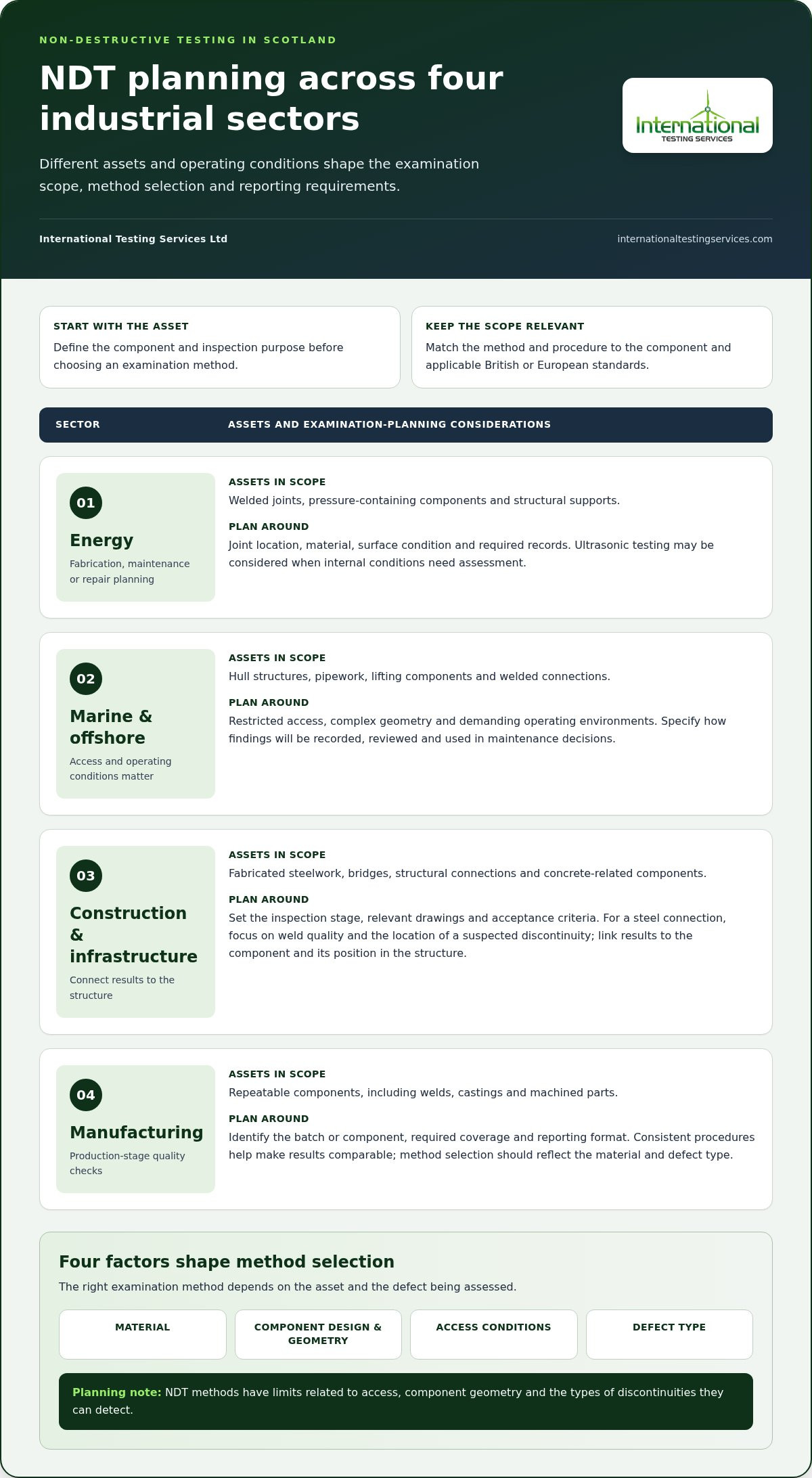
In Scotland, NDT supports inspection planning across energy, maritime, construction, manufacturing and infrastructure projects. Each sector involves different materials, component shapes and operating conditions. A welded pipe in an energy installation, for example, presents a different examination task from a cast manufacturing component. Define the asset and inspection purpose first, then select a method suited to the expected defect, access and acceptance criteria.
Energy projects may involve welded joints, pressure-containing components and structural supports. International Testing Services Ltd provides expert inspectors who can assess weld integrity during fabrication, maintenance or repair planning. The work scope should identify the joint location, material, surface condition and required records. Ultrasonic testing may be considered where the examination needs to assess internal conditions. The method and procedure must suit the specific component and relevant British or European standards.
Marine and offshore assets present distinct inspection conditions, including restricted access, complex geometry and demanding operating environments. International Testing Services Ltd helps ensure a practical scope identifies whether the target is a hull structure, pipework, lifting component or welded connection. Access arrangements affect how the examination is carried out. Inspection plans should also specify how findings are recorded, reviewed and used in maintenance decisions.
Construction and infrastructure projects use NDT to examine fabricated steelwork, bridges, structural connections and concrete-related components. For a steel connection, International Testing Services Ltd ensures the inspection focuses on weld quality and the location of a suspected discontinuity. Before testing, the project team should establish the inspection stage, relevant drawings and acceptance criteria. Clear reporting links the results to the component and its position in the structure.
Manufacturing involves repeatable components and production-stage quality checks. A manufacturer may partner with International Testing Services Ltd to examine welds, castings or machined parts before assembly. The inspection plan should identify the batch or component, required coverage and reporting format. Consistent procedures help make results comparable, while method selection must reflect the material and defect type.
- Energy: define the weld or component, examination stage and applicable acceptance criteria with International Testing Services Ltd.
- Marine: account for access and geometry when planning inspection of structures or pipework with International Testing Services Ltd.
- Construction: connect each result to the relevant drawing, joint and structural location through International Testing Services Ltd.
- Manufacturing: specify component identification, inspection coverage and records for production review with International Testing Services Ltd.
Across these sectors, certification and inspection records serve different purposes. Certification may relate to personnel or a defined process, while an inspection report records the examination performed and its findings. Project documentation should state the required deliverable rather than treating these terms as interchangeable. A useful next step is to plan a project-specific inspection scope around the asset, method and applicable British or European requirements with International Testing Services Ltd.
NDT examinations
Non-destructive testing examines equipment, materials and components for surface and subsurface imperfections without damaging them. A welded connection, for example, may need to be assessed for discontinuities that could affect its intended use. The examination provides evidence for inspection decisions, but its findings apply only to the area examined using the chosen method.
Start planning with the component and the question the examination must answer. Identify the material, shape, accessible surfaces and likely defect location. A surface examination may suit a different requirement from testing for indications below the surface. Choose a method that fits the component and inspection objective, rather than relying only on a familiar technique.
Ultrasonic examination uses sound waves to assess material below an accessible surface. Its suitability depends on factors such as component geometry, material properties and probe access. Magnetic Particle Inspection identifies relevant surface or near-surface indications in suitable ferromagnetic materials. Liquid Penetrant Inspection can reveal surface-breaking discontinuities on suitable, clean surfaces. Each method has limits, and a result cannot establish the condition of every part of a component automatically.
Examination follows a planned sequence. First, confirm the component identity and inspection area. Then prepare the surface or access arrangement required by the selected method. The examiner carries out testing to the agreed procedure, records indications and evaluates the results against the project’s acceptance criteria. Accurate identification matters: each finding must be traceable to the component location and examination record.
- Define the purpose: state the component, suspected condition and required inspection coverage.
- Select the method: account for material, geometry, access and the type of indication sought.
- Record the examination: link findings to the component and inspection area.
- Interpret the result: compare recorded indications with the applicable acceptance criteria.
Reports describe the work performed, the areas examined and the findings identified. They support decisions such as further assessment, repair planning or acceptance under project requirements. A report should not imply that unexamined areas were assessed. For example, examining one weld locally does not mean every weld on the same structure was examined.
NDT can also be part of a technical career involving practical inspection, result interpretation and quality records. The work requires attention to procedures, component identification and accurate reporting. Further technical responsibilities may include reviewing examination procedures or findings, depending on the role and qualification route. These functions are distinct from destructive testing, which alters or damages the test item to assess its properties.
For NDT work in Scotland, define the examination scope against the applicable British or European requirements and component acceptance criteria. NDT examinations in Scotland should align method selection, inspection coverage and reporting with the project decision they must support.
What qualifications and certifications do NDT technicians need to work in Scotland?
NDT technicians need method-specific competence suited to the work they perform. In Scotland, the Peterhead Non-Destructive Examination apprenticeship offers one structured route into the occupation. It lasts five years and combines workplace learning with technical education and supervised practice. This is one example of a training route, not a universal requirement for every NDT role.
The Peterhead programme includes a Modern Apprenticeship in Non-Destructive Examination and a National Certificate (NC) in Measurement and Control. It also includes PCN Level 2 qualifications in dye penetrant, magnetic particle, ultrasonic and radiographic inspection. These credentials relate to particular examination methods. A project’s method and applicable British or European standards determine which technical competence is relevant to the assigned work.
Applicants preferred for the apprenticeship have National 5 or equivalent qualifications in Mathematics and English. Candidates who meet the entry requirements are invited to undertake an aptitude test as part of selection. These steps assess entry suitability for the programme; they do not substitute for method training or practical development during the apprenticeship.
Training combines college attendance and workplace experience. Apprentices attend college on day release during years 1 and 2. Each year, they also receive off-site training with a Level 3 Non-Destructive Examination technician. This gives the programme recurring technical instruction alongside practical exposure. Additional in-house training covers positive material identification, ferrite testing, hardness testing and calibration.
When reviewing a technician’s qualifications for a task, connect the credential to the actual inspection scope. A PCN Level 2 qualification in ultrasonic inspection, for example, is relevant to ultrasonic work, not automatically to another examination method. Check that the method, component and procedure align with the project’s technical requirements and applicable standards. Level 3 expertise has a different function: it can support technical oversight and independent verification for critical industrial applications.
- Identify the method: establish whether the work requires ultrasonic, magnetic particle, dye penetrant or radiographic inspection.
- Match competence to scope: relate the technician’s method-specific qualification to the planned examination.
- Review the work records: ensure the examination procedure and reporting requirements align with the applicable project standards.
The apprenticeship’s five-year structure shows how technical qualification can develop through formal learning and supervised practice. For employers, the practical question is whether the assigned technician’s competence matches the examination method, component and required records. For prospective technicians, the Peterhead pathway sets out a defined combination of entry preparation, college study, in-house instruction and annual Level 3 training.
What UK and Scottish regulations and standards apply to NDT inspections?
No single NDT standard covers every inspection in Scotland. Applicable requirements depend on the asset, industry, examination method and project specification. British and European standards provide the technical framework when cited by the governing specification. A welded component, pressure-related asset and structural connection may therefore have different inspection criteria and documentation requirements.
Distinguish legal requirements from technical standards. Regulations may set duties for particular work or equipment, while standards describe technical practices, methods or acceptance criteria. A standard may apply through a contract, design basis or regulatory reference. Its relevance depends on the project context. Do not assume that a standard for one component governs another simply because both use the same NDT method.
Start with the asset documentation. Identify the design or construction specification, inspection purpose and relevant contract requirements. Then establish which British or European standards the project cites for the method and acceptance criteria. An ultrasonic examination procedure and the criteria for assessing its indications are related, but not interchangeable. The inspection record should clearly identify the governing documents.
The method matters. Ultrasonic, magnetic particle, liquid penetrant and radiographic examinations use different techniques and produce different types of indications. The applicable standard or specification should match the method and component. For a welded joint, the scope should link the required examination, coverage and evaluation criteria to that joint. A general reference to “NDT” does not define these technical details.
- Identify the asset: record its type, material, construction details and inspection purpose.
- Review governing documents: locate the project specification, design basis and cited British or European standards.
- Define the examination: specify method, coverage, procedure and applicable acceptance criteria.
- Control records: link reports and findings to the component and governing requirements.
Projects in Scotland may involve UK-wide requirements as well as British and European technical standards. The location alone does not determine the correct inspection standard. A fabricated structure and an operational plant component, for example, may have different governing specifications even when examined in the same region. Project documentation determines how the requirements apply.
Keep the inspection scope traceable. A report should identify the examination method, component, examined area and criteria used to evaluate findings. This allows the project team to compare the result with its specified requirements, rather than relying on an unexplained pass or fail statement. For a standards-aligned examination scope, discuss your inspection requirements with a technical specialist.
International Testing Services: Phased Array Inspection
International Testing Services provides Phased Array Inspection for projects requiring detailed ultrasonic examination. This method can support inspection planning where the component, access and examination objectives suit phased array. The scope should define the area to be examined, applicable acceptance criteria and reporting requirements under relevant British or European standards.
Consider this service when a project needs specialist examination and documented findings to support quality assurance or engineering decisions. International Testing Services also provides TOFD Inspection, Ultrasonic Inspection and Magnetic Particle Inspection for requirements suited to those methods. Selection depends on the component and inspection purpose, not simply on a preferred technique.
For a project-specific discussion of inspection requirements, contact International Testing Services.
Define the next inspection step
Move from general requirements to a defined scope for the asset under review. Record the component, examination objective, access conditions and applicable British or European standards. This gives the technical discussion a clear basis and helps align the selected method with the project’s inspection needs. For NDT in Scotland, a focused scope is a practical starting point for planning examination and reporting.
International Testing Services provides Phased Array Inspection, TOFD Inspection and Ultrasonic Inspection. These methods can be considered according to the component and examination objective. Discuss the inspection requirements with the technical team to identify an appropriate approach for the work.
Contact International Testing Services to discuss your inspection requirements and move your project planning forward with a clearly defined scope.
Frequently Asked Questions
What does NDT mean in Scotland, and what services are available?
NDT means non-destructive testing, an examination approach that assesses materials or components without damaging them. In Scotland, available services include ultrasonic, phased array, TOFD, magnetic particle, visual and liquid penetrant inspection. International Testing Services provides these methods alongside welding inspection, positive material identification and Level 3 consultancy. Select the service according to the component and inspection objective, then define the required records and applicable project standards.
Where are NDT inspection companies and testing facilities located across Scotland?
NDT work in Scotland can be planned around the asset’s location, including an industrial site or fabrication setting. International Testing Services is based in Methil, Fife, and provides on-site inspection services across the UK and internationally. For a project elsewhere in Scotland, the asset location, access arrangements and examination scope help shape the practical plan. Not every inspection task requires a fixed testing facility.
Which NDT methods are commonly used in Scotland, such as ultrasonic, radiographic, magnetic particle, and dye penetrant testing?
Common methods include ultrasonic, radiographic, magnetic particle and dye penetrant testing. Ultrasonic examination assesses material internally using sound waves; magnetic particle testing is suited to suitable ferromagnetic materials. Dye penetrant testing reveals surface-breaking indications on suitable surfaces. Radiographic testing produces images for examination and interpretation. International Testing Services provides Ultrasonic Inspection, Magnetic Particle Inspection and Liquid Penetrant Inspection, and radiography interpretation is a separate technical service.
What Scottish industries use NDT, including oil and gas, renewables, construction, and aerospace?
NDT supports inspection across oil and gas, renewables, civil construction, maritime, petrochemical and nuclear work. Typical assets include welded structures, plant components, bridges and vessel structures. Aerospace also uses examination methods to assess components, though requirements depend on the aircraft part and governing specification. International Testing Services serves oil and gas, renewables, nuclear, maritime, civil and petrochemical sectors, with inspection scope determined by each project.
How can I choose and book an NDT inspection provider in Scotland?
Start by documenting the component, inspection objective, material, access constraints and required report. Match these details to the examination method and the British or European standards cited by the project. International Testing Services can discuss a defined inspection scope through its website contact form or by telephone. Include drawings, component identification and the relevant project specification when describing the work, so the inspection requirements are clear from the outset.
What are the differences between NDT methods, and how do I choose the right one?
Methods differ in the indications they reveal, the materials they suit and the access they require. Magnetic particle examination, for example, applies to suitable ferromagnetic materials, while liquid penetrant examination identifies surface-breaking indications. Ultrasonic methods assess internal conditions, with the approach depending on component geometry and inspection objective. Define the required coverage and acceptance criteria first, then select a method that fits the material and project specification.


