
DNV approval applies to NDT service suppliers working on offshore projects or units. A DNV Approved NDT Supplier is assessed for its equipment, personnel, qualifications, testing capability and quality documentation, including the material thickness it can inspect. Approval relates to defined capabilities, not blanket endorsement of every method or project.
For engineering and project teams in Scotland, the distinction matters: supplier approval, procedure acceptance and inclusion in an approved company listing address related but separate questions. This article explains how DNV approval applies to offshore work, what is assessed, how NDT procedures and companies are considered, and what approved manufacturer and supplier listings can establish. It also clarifies where specialist NDT inspection and technical oversight fit into project quality assurance.
Key Takeaways
- Understand how DNV approval relates to NDT suppliers working on offshore projects and units.
- Identify the equipment, personnel, qualifications and quality documentation considered during supplier assessment.
- Distinguish approval of a supplier from assessment of its NDT procedures and defined capabilities.
- Learn what an approved company listing can help establish when selecting subcontractors for NDT work.
- Explore how inspection methods such as phased array, TOFD and ultrasonic testing fit into project quality assurance.
Non-destructive testing for offshore projects and units
DNV approval applies to NDT service suppliers working on offshore projects or units. Assessment considers the supplier’s equipment, personnel, qualifications, testing capability and documentation controls.
Supplier Requirements and Personnel Qualifications
Personnel qualifications are assessed against the NDT methods and work scope they will perform. DNV considers whether the supplier has suitable personnel, equipment and qualifications for the testing. The review also considers whether records support quality control and traceability across inspection activities.
No single certificate should be assumed to cover every method or project. Relevant qualifications depend on the assigned technique and project requirements. For example, an ultrasonic testing procedure should be supported by personnel qualified for that inspection work.
Offshore inspection planning should connect the component, material and defect concern to the proposed test. Welded products and materials intended for the maritime industry require reliable testing. A supplier’s documented capability helps project teams assess whether its methods and equipment suit the inspection scope.
Material thickness limits form part of the assessment. DNV considers the maximum material thickness a supplier can measure and test under its rules. Project teams should define the component thickness and inspection requirement before assigning the work, then compare the supplier’s stated capability with that scope.
Underwater ultrasonic testing can examine subsea structures, including pipelines, hulls and offshore platforms. For diver-supported inspection, define the target area, access conditions and required examination in the work scope. Clear records link the inspected location and findings to the structure, supporting traceability after the underwater work is complete.
Coating inspection has a separate approval context. DNV offers approval for suppliers testing coating systems under IMO PSPC. Project documentation should identify the coating system and applicable inspection requirements so the supplier’s approval and testing scope align with the work.
Steps for Hiring an NDT Supplier
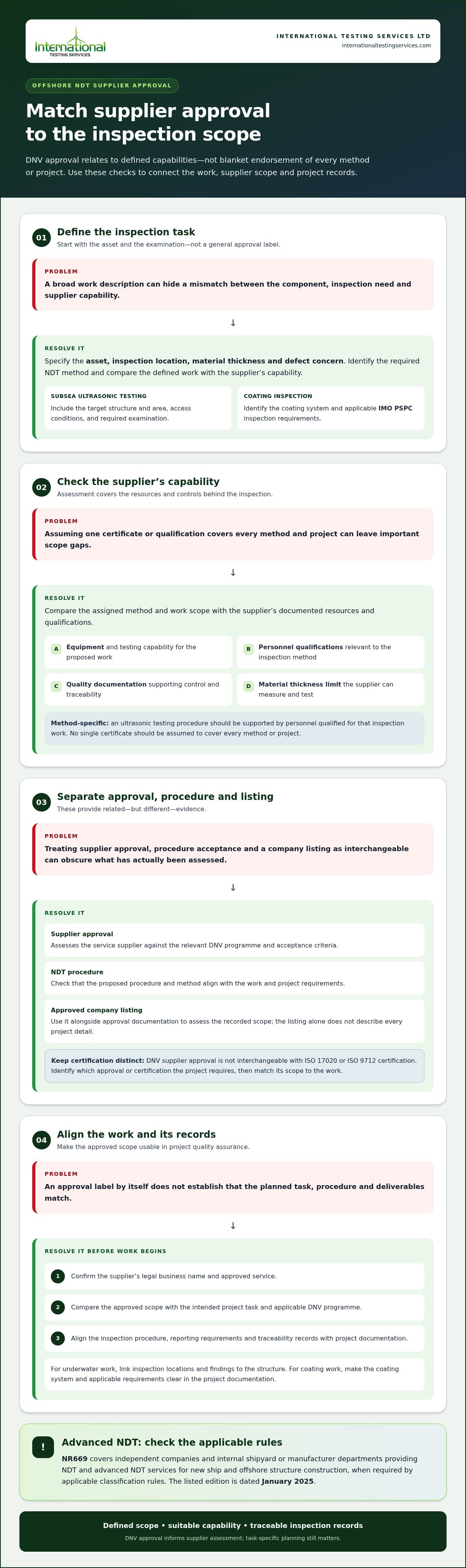
Start by defining the asset, inspection location, material thickness and defect concern. Then identify the required NDT method and compare the scope with the supplier’s approved capabilities, equipment and personnel qualifications. Before work begins, align the inspection procedure, reporting requirements and traceability records with the project documentation.
For diver-supported ultrasonic testing, include subsea access and the target structure in the scope. For coating work, identify the IMO PSPC requirements. These steps help teams determine whether the supplier’s defined capability matches the inspection task, rather than relying on a general approval label.
DNV offers approval for suppliers conducting in-water surveys of ships. This is relevant when the planned work is an in-water ship survey. Identify whether the activity falls within the supplier’s intended assignment before considering the approval.
DNV approval requirements for service suppliers
DNV approval programmes set procedures and acceptance criteria for service suppliers. Approval assesses a business’s qualifications, capability and service delivery against DNV rules.
DNV Approval and ISO Certification
DNV approval assesses a service supplier against the relevant DNV approval programme and its acceptance criteria. ISO 17020 or ISO 9712 certification should not be treated as interchangeable with that supplier approval. For procurement, identify which approval or certification the project requires, then match its scope to the work.
The distinction matters for advanced NDT services. NR669 covers independent companies and internal shipyard or manufacturer departments providing NDT and advanced NDT services for new ship and offshore structure construction, when required by applicable classification rules. Its listed edition is dated January 2025.
Verifying Approval Certificates and Scope
Compare the supplier’s approval evidence with its legal business name, approved service and intended project scope. Check that the methods and work align with the applicable DNV programme and acceptance criteria. For NDT, distinguish standard methods from advanced NDT services where the project scope requires it.
DNV lists approved manufacturers and suppliers in its list of approved companies. Use the listing alongside approval documentation to assess whether the supplier’s recorded scope matches the task. A listing alone does not describe every project detail or replace a review of the inspection requirements.
Service suppliers performing work relevant to ship operations or classification need approval when serving DNV ships. The requirement depends on the service, the vessel’s DNV connection and the applicable classification rules. Confirming these elements during procurement helps prevent a mismatch between the work order and supplier approval.
For cathodic protection inspection or related services, define the required activity precisely. Cathodic protection and NDT are distinct technical scopes; NDT approval is not evidence of approval for cathodic protection work. Set out the asset, inspection objective and deliverables, then compare them with the supplier’s documented approval scope.
Where DNV approval is required, using a supplier without valid approval can leave the project without evidence that the service provider met the applicable acceptance criteria. A mismatch between approval scope and work can also complicate classification-related review. For advanced NDT, identify the applicable rules before appointing a supplier.
DNV approval can inform procurement decisions, but it does not replace task-specific planning. Define the service, confirm the approval scope, and align the required procedure and records with project documentation. This helps project teams assess supplier suitability throughout the work instead of relying on a certificate title alone.
Approval of NDT procedures and companies
Company approval and procedure review address different parts of NDT control. DNV assesses whether an NDT company has suitable equipment, including devices for methods such as isotope X-raying. It also checks whether procedures and supporting documentation comply with relevant international standards. Project teams should distinguish the supplier’s assessed capability from the method-specific instructions governing an examination.
Start a practical review with the inspection task. Identify the component, examination objective and proposed NDT method, then compare them with the company’s documented capability. Isotope X-raying, for example, requires appropriate devices. A general company approval label alone does not describe every technique or task the supplier can undertake.
Procedure compliance depends on whether instructions provide inspectors with a controlled basis for examination. Review the method, application, equipment references and required records against the relevant international standards. DNV’s assessment considers whether procedures and documentation comply with those standards. Clear document control helps teams identify the procedure that applies to each examination.
Company scope also matters for specific ship components. DNV offers approval for suppliers examining Ro-Ro ship bow, stern, side and inner doors. For work involving one of these doors, identify the exact component and examination scope in the work documentation. This lets the team compare the approval context with the task before inspection begins.
Use a simple review sequence to connect approval, procedure and work package:
- Define the component and examination objective, such as a Ro-Ro ship side door.
- Identify the proposed NDT method and the equipment needed for that method.
- Review the procedure and supporting documents against relevant international standards.
- Align the planned work and inspection records with the company’s assessed capability.
This sequence is useful when a project changes its inspection scope. If a work package changes from a Ro-Ro door examination to isotope X-raying, compare the method and equipment references again. Reflect the change in the procedure and associated records so the inspection team works from applicable instructions.
For procurement, retain the connection between the company’s scope, the selected procedure and the component examined. A traceable file should identify the applicable procedure and its examination records. This supports consistent review across ship construction and offshore structure work where applicable classification rules call for NDT services.
If the work also involves manufacturer approval, keep that review distinct from NDT company approval. DNV's manufacturer approval procedure includes inspection of the manufacturing plant and testing materials, manufacturing processes and products for compliance with relevant rules. In the work file, specify whether the requirement concerns manufacturer approval, NDT company approval or both, and keep the relevant evidence with the applicable scope.
For NDT company records, DNV checks whether the documentation system supports quality and ongoing traceability. Keep this system-level check distinct from procedure review: the procedure sets out examination instructions, while the documentation system supports quality and traceability. Organising approval material around these purposes helps maintain a clear record of the company assessment, applicable procedure and examination documentation.
Listing approved manufacturers and suppliers
DNV’s list of approved companies includes approved manufacturers and service suppliers. For project teams, it is a starting point for identifying companies in a relevant approval category. DNV also assists companies in selecting subcontractors for non-destructive testing. The listing supports selection, but the planned work must still match the company’s recorded approval scope.
Manufacturer approval is distinct from approval for NDT service work. DNV’s manufacturer approval procedure includes inspection of the manufacturing plant and testing materials, manufacturing processes and products for compliance with relevant rules. After successful completion, DNV issues a Manufacturer Approval Certificate. This process evaluates production and product conformity, rather than establishing an NDT supplier’s inspection capability.
DNV manufacturer approval programmes cover a range of product and technical areas, including:
- Steelmaking, rolled steel products and steel forgings.
- Foundries, aluminium alloys, tubes and pipes.
- Chain cables and steel wire ropes.
- System and software engineering.
These categories clarify what an approval concerns. For example, manufacturer approval involving steel forgings relates to conformity within that manufacturing area. It should not be interpreted as approval for unrelated products or NDT services. Procurement records should state whether the project needs an approved manufacturer, an NDT supplier, or both.
DNV uses different assessment arrangements for product quality and inspection. Manufacturer Product Quality Assessment, or MPQA, assesses a company’s quality control processes for its products. Manufacturing Survey Arrangements, or MSA, allow certain product inspections and tests without a DNV surveyor present. These arrangements serve different purposes, and their relevance depends on the product and inspection requirements.
Alternative Product Certification, or APC, is an alternative procedure for maritime components. Its role differs from an approved-company listing: APC concerns a product certification procedure, while the list identifies approved manufacturers and suppliers. Keeping these distinctions clear helps engineering and procurement teams select the appropriate route for each component or service.
For NDT subcontracting, use a structured review rather than relying on a company name alone:
- Identify the inspection service required for the project.
- Locate relevant approved companies in DNV’s listing.
- Compare the supplier’s approval scope with the planned NDT work.
- Keep the selection rationale and applicable approval records with procurement documentation.
This process is particularly useful when a manufacturer appoints an NDT subcontractor for a product examination. A manufacturer approval certificate covers the approved manufacturing area; the NDT supplier’s approval covers its service scope. Separating these records helps distinguish product conformity from inspection capability and maintain a clear procurement trail.
Which NDT methods can DNV-approved suppliers perform?
Approved methods depend on the supplier’s assessed capability and project scope. DNV assesses whether the company has suitable equipment, personnel and qualifications for its work. Match the required examination to the supplier’s specific method capability, rather than treating approval as coverage of every NDT technique.
Common methods address different inspection needs. Ultrasonic testing uses sound waves to examine material and weld integrity. Phased array and time-of-flight diffraction, or TOFD, are advanced ultrasonic techniques. Their suitability depends on the component, examination requirements and applicable procedure. Magnetic particle testing and liquid penetrant testing use different principles to examine surface or near-surface discontinuities.
Visual inspection examines accessible surfaces and features directly. Radiographic testing uses radiation to examine internal features, while isotope X-raying requires suitable devices. DNV assesses whether an NDT company has equipment suitable for methods such as isotope X-raying. The equipment, method and documented procedure must match the assigned work.
Other specialist methods address particular assets or defect types. Alternating Current Field Measurement, or ACFM, is an electromagnetic NDT method used to detect and size subsea surface-breaking cracks. Underwater ultrasonic testing can inspect subsea pipelines, hulls and offshore platforms. These examples show why the inspection location and target condition matter when choosing a method.
For practical method selection, define the inspection objective first. Match the component and access conditions to the method, equipment and personnel capability. Consider whether the examination concerns a weld, accessible surface, internal feature or subsea crack. The procedure should explain how the examination will be performed and recorded, linking the requested result to the technique used.
DNV supports companies in selecting an NDT method suited to their requirements. The decision depends on the asset, material, defect concern and inspection conditions. For example, a method selected for accessible surface cracking may not address an internal weld concern in the same way. Describe the required outcome before specifying a technique.
For Scotland-based offshore and maritime work, align the selected method with British and European project requirements and applicable classification rules. Define the inspection area, method, procedure and reporting needs in the work scope. This gives the supplier a precise basis for planning and helps project teams assess whether the proposed technique addresses the identified concern.
For method-specific inspection planning, discuss your NDT inspection requirements with a specialist team.
DNV assesses whether personnel have qualifications suited to the supplier’s work. Their qualifications and method capability should match the specific examination and project scope.
International Testing Services: Phased Array Inspection
International Testing Services Ltd provides Phased Array Inspection for projects requiring focused ultrasonic examination. This method can support the evaluation of welds and components when the project specification calls for phased array testing. Its use should align with the inspection objective, applicable procedure and British or European project requirements.
Where another technique is required, International Testing Services Ltd also provides TOFD Inspection, Ultrasonic Inspection and Magnetic Particle Inspection. Defining the component, examination area and required outcome helps identify a suitable method. The inspection method is distinct from DNV Approved NDT Supplier status, which relates to the supplier’s assessed scope.
For inspection planning in Scotland, contact International Testing Services Ltd to discuss your NDT requirements.
Set the Inspection Scope Before Work Begins
For your next Scottish offshore or maritime project, turn the inspection requirement into a clear work scope. Identify the component, examination objective, method and required records. This gives procurement and engineering teams a defined basis for aligning supplier capability with project requirements. Consider a DNV Approved NDT Supplier in relation to its assessed scope and the specific work, not as a general endorsement of every inspection activity.
For specialist examination, International Testing Services offers Phased Array Inspection, TOFD Inspection and Ultrasonic Inspection. The appropriate method depends on the inspection objective and component. A clearly defined requirement provides a sound basis for technical discussion before work is planned.
For project-specific NDT requirements, contact International Testing Services. A disciplined scope is a practical starting point for planning inspection work with clarity.
Frequently Asked Questions
What does DNV approval mean for an NDT supplier?
DNV approval means a supplier has been assessed against the relevant DNV programme for its service scope. For a DNV-approved NDT supplier, assessment considers whether qualifications, capability and service delivery align with applicable requirements. Read approval in context: the project team must still match the approved scope to the inspection task, such as examining a specified weld or component.
How can I find DNV-approved NDT suppliers in the United States?
For a Scotland-based project, begin with the inspection scope and applicable British or European project requirements, then identify suppliers whose DNV approval matches the work. For a project in the United States, use its DNV classification context and required inspection scope to guide supplier selection. In either location, assess the supplier against the actual task, not location alone.
Where is the official DNV list or database of approved NDT suppliers?
DNV includes approved manufacturers and suppliers in its list of approved companies. Search the listing for relevant NDT service suppliers, then review their approval documentation alongside the project scope. Consider a supplier’s listing in relation to the required method and inspection task, rather than as evidence of every possible NDT capability. The listing and supporting approval information serve complementary purposes.
What are DNV requirements for supplier audits and quality management?
DNV’s service supplier programmes set approval procedures and acceptance criteria. Assessment considers supplier qualifications, capability and delivery, while documentation should support quality control and ongoing traceability. For a practical quality review, map inspection records to the procedure, method and work performed. The applicable programme sets the assessment criteria, so do not assume a particular audit interval or format without checking its requirements.


