
For new construction of ships and offshore structures, a BV (Bureau Veritas)-approved NDT supplier operates within the scope of Bureau Veritas Rule Note NR669 when applicable classification rules require NDT or advanced NDT. The listed edition, NR669 R01, is dated January 2025.
That distinction matters: approval should be assessed against the work, applicable classification requirements and the supplier’s recognised scope, not treated as a blanket endorsement for every inspection task. The rule applies to independent companies and to internal shipyard or manufacturer departments providing these services.
If you’re assessing a supplier for a project in Aberdeen or elsewhere in Scotland, the practical question is whether its recognition matches the required inspection methods and project scope. This article explains what NR669 covers, how to assess recognition against the work being planned, and where NDT methods and technical oversight fit into the decision. It provides a clear basis for discussing compliance and inspection requirements before work proceeds.
Key Takeaways
- Assess recognition against the project’s specific inspection scope and applicable classification requirements, rather than treating approval as universal.
- Use Bureau Veritas Rule Note NR669 to understand the supplier requirements relevant to NDT for new ship and offshore structure construction.
- When reviewing recognition, align the required NDT methods and project scope with the work being planned.
- Phased Array Inspection, TOFD Inspection, Ultrasonic Inspection and Magnetic Particle Inspection are methods to consider according to the inspection task.
BV (Bureau veritas) Approved NDT Supplier
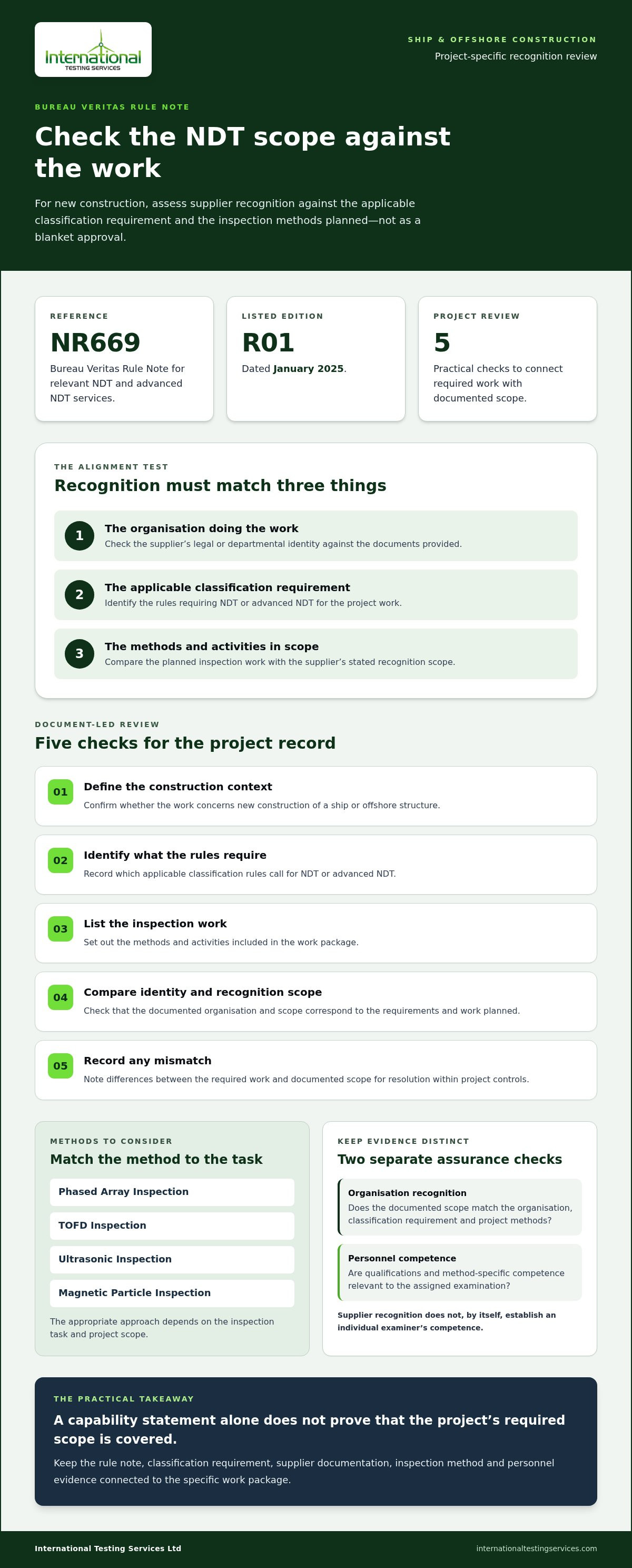
For new construction of ships and offshore structures, Bureau Veritas Rule Note NR669 applies to independent companies and internal shipyard or manufacturer departments providing NDT and advanced NDT services when applicable classification rules require them. The listed edition, NR669 R01, is dated January 2025. Its scope connects recognition to a defined work context, rather than establishing a universal approval for every NDT activity.
That scope is the starting point for a project review in Aberdeen or elsewhere in Scotland. Identify the asset, construction phase and inspection work required by the applicable classification rules. Then compare those requirements with the supplier’s stated recognition and the methods it will perform. General NDT capability alone does not establish that recognition covers a specific work package.
Use a document-led review. Record the supplier’s legal or departmental identity, relevant recognition reference, stated scope and the NDT methods required for the project. Check that the same organisation and scope appear consistently in the documents provided for the work. This helps distinguish recognition relevant to shipbuilding inspection from recognition covering a different activity or service.
Apply these practical checks to the project record:
- Define whether the work concerns new construction of a ship or offshore structure.
- Identify which applicable classification rules require NDT or advanced NDT.
- List the inspection methods and activities in the work package.
- Compare the supplier identity and recognition scope with those requirements.
- Record any difference between the required work and the documented scope for resolution within project controls.
These steps do not expand NR669 beyond its stated purpose. They make the relationship between the rule note, the classification requirement and the contracted inspection task visible. For example, a project that requires advanced NDT should assess the documented scope against that specific activity, not infer coverage from a supplier’s broader description of its capabilities.
Keep the technical work package aligned with the recognition review. Inspection procedures, method selection, personnel competence and reporting expectations should all relate to the specified examination. A method listed on a capability statement does not, by itself, prove that the project’s required scope is covered. Connect the planned examination to the relevant project requirement and supplier documentation.
Personnel competence is separate from organisational recognition. Review the qualifications and method-specific competence relevant to the assigned examination alongside the recognition scope. This lets project teams assess both who will carry out the work and whether the organisation’s documented role matches the task. Keep the checks distinct: personnel credentials and supplier recognition address different aspects of inspection assurance.
For a BV (Bureau Veritas)-approved NDT supplier, the useful test is therefore project-specific: does the recognition relate to the organisation performing the work, the applicable classification requirement and the methods in scope? NR669 R01 provides the relevant reference for its stated new-construction context. A recorded comparison of these elements gives procurement and engineering teams a clearer basis for managing inspection compliance.
Keep adjacent qualification references distinct from the recognition being checked for the shipbuilding work. The National Institute of Standards and Technology (NIST) report lists Bureau Veritas (BV) among organizations with relevant guidelines and specifications for additive manufacturing qualification. That reference may be recorded where additive manufacturing qualification is relevant to the project, but it should not be treated as evidence, by itself, that the supplier’s documented NR669 scope covers a particular NDT task. Maintain the link between each reference and the work it addresses, so project reviewers can see which requirement or qualification it supports. Where the work package involves more than one activity, assess each against its own stated requirements and supporting documentation.
Read personnel evidence in context. The U.S. Environmental Protection Agency states that nondestructive testing examiners were required to be certified as Level II technicians competent in relevant methods under ASNT requirements. Where this requirement applies to the work under review, check records for the relevant method, examiner certification and competence, and retain the evidence with the inspection documentation. Do not assume supplier recognition establishes an individual examiner’s competence, or that a personnel requirement from one context automatically applies to another. Keeping supplier scope, method-specific personnel evidence and project classification requirements separate makes the review clearer and helps identify what needs confirmation before inspection proceeds. Record unresolved mismatches for the responsible project controls to address.
International Testing Services: Phased Array Inspection
International Testing Services Ltd provides Phased Array Inspection for projects requiring detailed ultrasonic examination of components or welds. The method can support inspection planning when the required coverage, component geometry and examination objectives are defined. Its suitability depends on the work scope, so align method selection with the project’s technical requirements.
For related examination needs, International Testing Services Ltd also provides TOFD Inspection, Ultrasonic Inspection and Magnetic Particle Inspection. These methods suit different inspection requirements, and the appropriate approach depends on the component and examination purpose. Defining the work scope helps identify the service that fits the task.
Contact International Testing Services Ltd to discuss Phased Array Inspection or related NDT requirements.
Align Your Inspection Plan With the Work Ahead
Before finalising an inspection package, align its documented scope with the project’s procurement and quality records. This gives engineering and project teams a clear basis for coordinating inspection requirements, work documentation and reporting expectations. It also keeps decisions about a BV (Bureau Veritas)-approved NDT supplier tied to the actual project scope, rather than a broad capability description.
Where the inspection plan requires additional NDT support, International Testing Services Ltd offers Phased Array Inspection, TOFD Inspection and Ultrasonic Inspection. Start by identifying the component and examination requirements for the work. A focused discussion can clarify how those requirements relate to the inspection approach.
For a project-specific discussion, contact International Testing Services Ltd. A clearly scoped inspection plan gives your team a practical starting point for the next stage of project delivery.


