
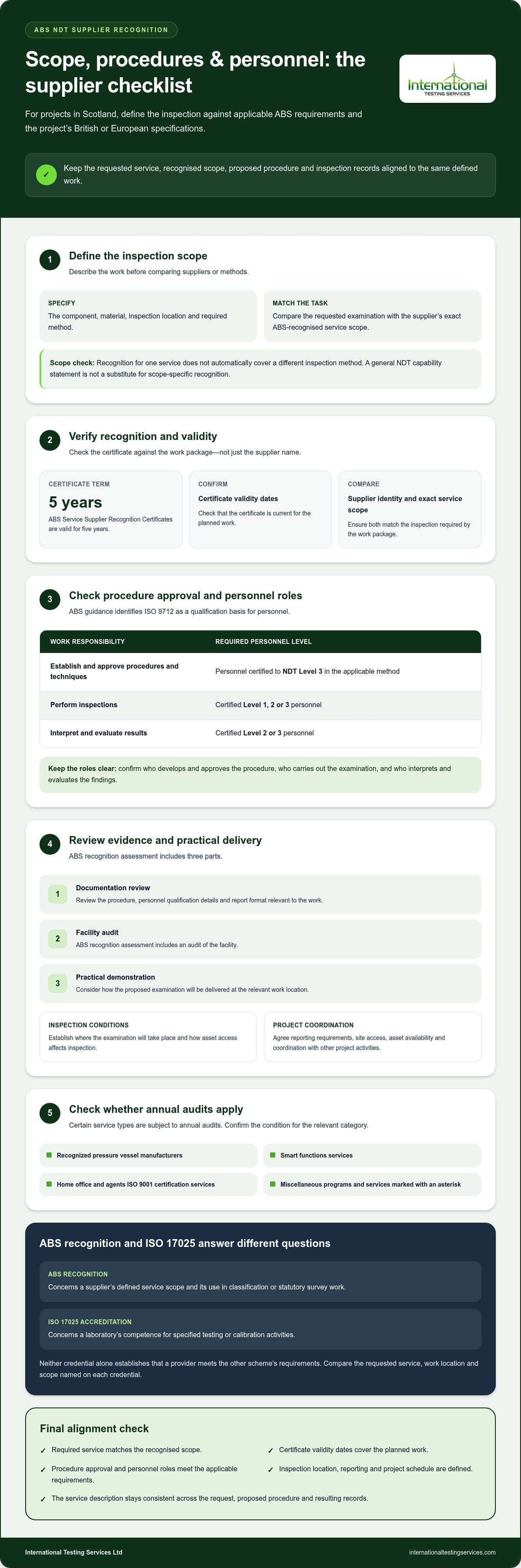
Procedural approval is central to ABS recognition. For an ABS Approved NDT Supplier, procedures and techniques must be established and approved by personnel certified to NDT Level 3 in the applicable method. Certified Level 1, 2 or 3 personnel may perform inspections, while interpretation and evaluation of results must be carried out by Level 2 or 3 personnel.
For engineering and quality teams, the distinction matters: the procedure needs accountable technical approval, and the people performing and evaluating the work must meet the relevant role requirements. This article explains procedure requirements and identifies which ABS service categories are subject to annual audits.
It also explains how ABS Service Supplier recognition applies to NDT work, what to consider when selecting inspection methods, and how Phased Array Inspection, TOFD Inspection and other services can support projects in Aberdeen and across Scotland. The focus is practical compliance and clear technical records.
Key Takeaways
- Understand the ABS recognition process and the evidence involved, from documentation review to practical demonstration.
- Identify which service categories are subject to annual audits and distinguish them from other recognition requirements.
- Compare inspection methods against the component, material and defect type to define a suitable NDT scope.
- Use the applicable ABS requirements to assess supplier documentation, including procedures, personnel records and inspection reports.
- See how phased array inspection and related NDT services can support inspection needs in Aberdeen and across Scotland.
ABS Service Supplier Recognition Program
ABS recognition assesses whether a service supplier can perform defined work for classification or statutory surveys. The programme also covers equipment manufacturing, inspection, testing and maintenance activities.
Comparing ABS Approval and ISO 17025 Accreditation
These credentials address different questions. ABS recognition relates to a supplier’s defined service scope and its use in classification or statutory survey work. ISO 17025 accreditation concerns a laboratory’s competence for specified testing or calibration activities. Neither label alone establishes that a provider meets the other scheme’s requirements. Compare the requested service, the work location and the scope named on each credential.
For an offshore weld inspection, the relevant evidence is ABS recognition covering that inspection service. Laboratory accreditation may be relevant when testing is performed by a laboratory, but it does not establish ABS service recognition on its own.
Applicable ABS Rules and Standards
ABS nondestructive inspection guidance identifies ISO 9712 as a qualification basis for personnel. Procedures and techniques must be established and approved by personnel certified to NDT Level 3 in the applicable method. Certified Level 1, 2 or 3 personnel may perform inspection; Level 2 or 3 personnel must interpret and evaluate results.
These role distinctions matter when defining who develops the procedure, carries out testing and reports findings. For construction or welding inspection, match the method, personnel roles and project scope to the applicable ABS requirements.
Confirming Current Approval and Service Scope
ABS Service Supplier Recognition Certificates are valid for five years. Check the certificate’s validity dates, supplier identity and exact service scope against the work package. A general NDT capability statement is not a substitute for scope-specific recognition.
ABS groups services into three families, and certain service types are subject to annual audits. These include recognized pressure vessel manufacturers, smart functions services, home office and agents ISO 9001 certification services, and miscellaneous programs and services marked with an asterisk. Check whether the relevant category carries that audit condition.
To hire a supplier, define the component and inspection method, match the required service to the recognition scope, then review the procedure and personnel roles. Agree on the inspection location, reporting requirements and project schedule before work begins.
Using a supplier whose approval has expired or does not cover the required service creates a scope mismatch. The inspection may then fail to satisfy the project’s ABS requirements, delaying acceptance or requiring further review. Valid scope and documented procedure approval help manage this risk.
This confirmation helps match a supplier to a defined task. Identify whether the work concerns classification or statutory surveys, or equipment manufacturing, inspection, testing or maintenance, and compare the task with the service being certified. This keeps the selection focused on requirements relevant to the work, rather than a general capability claim.
Before work begins, keep the service description consistent across the request, proposed procedure and resulting records. If the required service changes, reassess whether the certification covers the revised work. ABS service supplier certification confirms that services meet standards required for classification or statutory surveys, as well as equipment manufacturing, inspection, testing and maintenance activities.
Find ABS-approved NDT suppliers in the United States
For a project in Scotland, define the inspection scope against the applicable ABS requirements and the project’s British or European specifications. A supplier’s location is only one consideration. The method, asset, inspection location and required reporting outputs determine whether the proposed service fits the work package.
Use ABS recognition information to identify suppliers whose stated scope matches the required inspection. Then examine the supporting evidence and its relevance to the work. ABS assesses service supplier recognition through documentation review, a facility audit and a practical demonstration. Ask how the recognised service applies to the specific project, rather than relying on a general NDT capability statement.
- Define the work. Describe the component, material, inspection location and method required by the project specification. For a fabrication in Scotland, identify the welds or components and the applicable examination scope.
- Match the service scope. Compare the supplier’s ABS-recognised service with the specified inspection task. Do not assume recognition for one service covers another method.
- Review technical evidence. Request the procedure, personnel qualification details and report format relevant to the work. Check that these documents address the project specification and inspection objective.
- Assess practical delivery. Establish where the examination will take place, how access to the asset affects inspection, and how findings will reach the engineering and quality teams.
- Plan the schedule. Consider site access, fabrication or vessel availability, and coordination with other project activities. These factors shape the inspection sequence and agreed delivery plan.
For example, an offshore wind fabrication project in Scotland may require examination of specified welds before a construction stage proceeds. The supplier’s recognised scope, selected method and report outputs should align with project requirements. Record the agreed scope and deliverables in procurement documents so engineering, quality and site teams share the same inspection basis.
Directories and search results can help identify potential suppliers, but they do not establish that a particular service meets a project’s ABS and British or European requirements. Compare each candidate’s stated scope and technical evidence with the relevant work package. For cross-border projects, clearly define the inspection location and reporting expectations instead of relying on assumptions based on a supplier’s country of registration.
For work in Aberdeen or elsewhere in Scotland, prepare the component details and applicable project requirements before setting the inspection scope. This gives the technical discussion a clear basis; inspection planning support can help organise that scope.
Directories can help identify potential suppliers for projects with work in the United States. Use location as a way to identify candidates, then compare each supplier’s stated scope with the required method, component and inspection location. Request technical evidence tied to the work package rather than relying on a general capability statement.
Before appointment, agree on the inspection boundary, reporting outputs and delivery arrangements with the supplier. Keep procurement records aligned with the project specification, and ensure engineering, quality and site teams understand the same scope. Geographic reach alone does not replace checking recognition and practical suitability for the planned examination.
Which NDT methods can ABS-approved suppliers provide?
ABS recognition applies to a defined service scope, not automatically to every nondestructive testing method a supplier performs. The required technique depends on the component, material, geometry, likely defect and inspection access. For a welded joint, a project may specify ultrasonic examination; for a surface-breaking indication, Magnetic Particle Inspection or Liquid Penetrant Inspection may be relevant. The recognised scope and project requirements must align.
Common methods used for industrial inspection include:
- Ultrasonic testing: uses sound waves to examine material discontinuities, with the procedure matched to the component and inspection objective.
- Phased array ultrasonic testing: directs and focuses sound using multiple elements, supporting examination of welds and complex components.
- Time of flight diffraction: applies diffracted ultrasonic signals to assess weld indications and their dimensions.
- Magnetic particle testing: examines suitable ferromagnetic materials for surface or near-surface indications.
- Liquid penetrant testing: uses penetrant and developer to reveal surface-breaking indications on suitable, accessible surfaces.
- Visual inspection: assesses visible condition, workmanship and surface features against defined inspection criteria.
For example, Phased Array Inspection can provide encoded data for a weld scan, while Visual Inspection records visible surface condition. These methods produce different evidence. A technique selected for internal weld examination should not be treated as interchangeable with a surface examination method. The procedure, calibration, access and reporting requirements all shape the result.
Composite inspection is another distinct application. Ultrasonic nondestructive evaluation can scan layered and homogeneous composite materials for defects. Scans of multilayer carbon fibre and e-glass composites can show a defect’s size, shape and depth in real time. Material lay-up and access influence the examination plan, so the method must suit the construction being assessed.
Choose the method by defining the inspection question first. Is the target a weld discontinuity, a surface-breaking indication, a visible condition or a defect within layered composite? Then identify the material type, component geometry, access and required records. An NDT procedure should connect those conditions to the chosen technique and acceptance criteria.
Destructive testing evaluates material by damaging or consuming a specimen; NDT examines components without that test approach. The distinction matters when an in-service asset must remain intact. However, an NDT method’s suitability still depends on the target defect and applicable project requirements.
For ABS work, verify that the supplier’s recognised service scope covers the specific method required. Do not assume that a supplier performing Ultrasonic Inspection also holds recognition for Magnetic Particle Inspection or another technique. Match the method, procedure and reporting output to the asset and inspection objective.
What ABS rules and standards apply to NDT suppliers?
ABS requirements connect the inspection method, technical procedure and personnel roles to the work being performed. Nondestructive testing, inspection and evaluation are listed as ABS Rule-required services. For project teams, the practical task is to identify the governing ABS requirement and translate it into a controlled inspection scope.
ABS nondestructive inspection guidance identifies ISO 9712 as a qualification basis for personnel. It requires procedures and techniques to be established and approved by personnel certified to NDT Level 3 in the applicable method. Certified Level 1, 2 or 3 personnel may perform inspection; Level 2 or 3 personnel must interpret and evaluate results. These responsibilities should be clear in the procedure and inspection records.
Procedure development should connect the inspection objective to the component and method. A useful document identifies the item being examined, relevant material and geometry, examination area, chosen technique and reporting route. It should also define how the work will be recorded, including the results needed for engineering review. These are practical procedure elements, not a substitute for project-specific ABS requirements.
For hull welds, the ABS Guide for Nondestructive Inspection of Hull Welds provides a relevant reference. The ABS-hosted edition cited for this topic has revisions marked 2004. That date identifies the edition described, not a general statement about every project’s governing requirements. The project documentation determines which applicable rules and references control the inspection.
Apply the requirements through a clear sequence:
- Identify the asset and work scope. Record whether the examination concerns a hull weld, another welded joint or a different component.
- Select the applicable method. State the technique and inspection objective, rather than relying on a broad NDT label.
- Assign technical roles. Identify who approves the procedure, performs inspection and evaluates findings, using the applicable personnel qualification basis.
- Define the record set. Specify the procedure revision, personnel details, inspection results and report format required for review.
A project involving a hull weld, for example, should link its inspection instructions to the relevant ABS reference and method. The procedure should explain how examination coverage and recorded findings address the stated objective. If the work changes, update the scope and controlled documents to reflect the revised task before inspection proceeds.
ISO 9712 and ABS requirements have distinct roles in this framework. ISO 9712 provides a personnel qualification basis identified by ABS guidance; it does not, by itself, establish that a procedure or service scope meets ABS project requirements. Teams should assess both personnel competence and the technical requirements governing the specific inspection.
What documents should I request from an ABS-approved NDT supplier
Request a document set that ties ABS recognition to the inspection scope and resulting records. Start with the service supplier recognition certificate and check that the supplier identity and service description match the proposed work. Then request the procedure governing the specific method, component and inspection location.
The procedure should show the project team how the inspection will be controlled. Review its method, examination area, equipment approach, reporting requirements and applicable acceptance criteria. For a welded joint, for example, it should identify the weld scope and explain how findings will be recorded. Compare its revision with the version referenced in the work package.
Request these records before work starts:
- Recognition evidence: the ABS certificate or recognition record, with the relevant service scope and validity information.
- Approved procedure: the method-specific document, including its revision and the applicable approval information.
- Personnel records: qualifications relevant to the method and assigned roles, including procedure approval, inspection and result evaluation.
- Equipment records: identification and calibration or verification records for equipment used during the examination.
- Inspection report format: a sample or agreed template showing how location, method, findings and disposition will be documented.
Check consistency across the file. The service on the ABS recognition record should correspond to the method in the procedure. Personnel records should align with assigned inspection roles, and equipment identification in the report should match the equipment records. These cross-checks can reveal gaps before inspection begins, rather than during report review.
Agree on the final deliverables in the work order. Specify whether the project requires examination records, indication locations, evaluation results, procedure revision details or supporting scan data. For example, a weld inspection package may need traceable weld identification and a report linked to the relevant drawing or weld map. Define these links before fieldwork.
After inspection, retain the completed report with the procedure revision and personnel details used for the task. This creates a coherent record for engineering review and future comparisons. If the report records a finding, its location and evaluation should clearly link the result to the inspected component and agreed criteria.
Use the document review to resolve scope mismatches before mobilising or beginning testing. To align procedure and inspection records with a defined NDT scope, discuss NDT documentation requirements.
International Testing Services: Phased Array Inspection
International Testing Services Ltd provides Phased Array Inspection for projects requiring detailed ultrasonic examination of welds and components. Phased array techniques can direct and focus sound beams, supporting systematic inspection and recorded assessment. Suitability depends on the component, inspection objective and applicable procedure.
Where the work scope calls for complementary ultrasonic examination, International Testing Services Ltd also provides TOFD Inspection and Ultrasonic Inspection. Define the component, inspection area and required reporting output to establish a clear technical scope for projects in Aberdeen or across Scotland.
For inspection planning aligned with your project requirements, contact International Testing Services Ltd.
Define the Inspection Scope for Your Next Project
Move from approval requirements to a clear inspection plan by defining the asset, examination objective and reporting needs. These decisions help determine which method fits the work and what evidence the project team needs to review. Assess an ABS Approved NDT Supplier against the specific service scope required, not a general capability statement.
International Testing Services offers Phased Array Inspection, TOFD Inspection and Ultrasonic Inspection for projects requiring these examination methods. Aligning the selected service with the component and inspection objective gives technical teams a practical basis for planning the work and reviewing its results.
For projects in Aberdeen or elsewhere in Scotland, prepare the component details, inspection requirements and relevant documentation before discussing the scope. Contact International Testing Services to discuss the inspection requirements for your project.
Frequently Asked Questions
What must NDT procedures contain under ABS Service Supplier?
An NDT procedure should define the method, inspection scope, technical responsibilities and reporting approach for the specific work. ABS guidance requires procedures and techniques to be established and approved by personnel certified to Level 3 in the applicable method. For example, a weld inspection procedure should identify the weld examination scope and how results will be recorded. Inspection may be performed by certified Level 1, 2 or 3 personnel; evaluation requires Level 2 or 3 personnel.
Where can I verify an NDT supplier's ABS approval or certification?
Verify approval against the ABS recognition certificate and its stated service scope. Compare the supplier identity, certificate validity dates and recognised service with the inspection required for your project. ABS Service Supplier Recognition Certificates are valid for five years. If additional confirmation is needed, use the certificate details when contacting ABS, and ensure the service description matches the exact method and work scope rather than a general NDT capability.


