
A radiograph can reveal an indication, but it cannot support a reliable weld-quality decision unless the image is adequate and the applicable acceptance criteria are clear. That is central to radiography interpretation services: the review must consider both the evidence in the film or digital image and the requirements set for the project. Uncertainty about image adequacy, review scope or how to act on a finding can complicate quality decisions.
A fit-for-purpose review starts with the relevant project documents and image evidence. BS EN ISO 17636-1:2022 and BS EN ISO 17636-2:2022 address radiographic techniques for film and digital detectors respectively. Acceptance criteria are addressed separately, including in the ISO 10675 series. The applicable standard and project-specific criteria should guide the interpretation, rather than being assumed from the image alone.
This article explains what industrial weld radiography interpretation covers, what information supports a meaningful review, and how to define its scope against British and European requirements. It also explains how to record findings as clear project actions and where related Level 3 consultancy can provide broader technical oversight.
Key Takeaways
- Define the review around the welds, records and decision the project needs, rather than treating image interpretation as the full inspection programme.
- Radiography interpretation services assess acquired film or digital images. Image acquisition is a separate activity.
- Provide clear weld references, examination coverage and relevant records so findings can be linked to the correct work.
- Set the applicable project criteria before review, then document findings in a way that supports clear next steps.
- International Testing Services Ltd interprets radiographic films and digital images to assess weld quality and identify internal voids or inclusions.
What Radiography Interpretation Services Cover for Industrial Welds
Industrial radiography interpretation evaluates acquired weld radiographs for visible internal indications and assesses them against the applicable project requirements. It reviews image evidence; it does not produce that evidence. Radiographic testing includes the examination process used to create images, while image acquisition and interpretation are separate activities. This distinction clarifies what the review can establish and what falls outside its scope.
In industrial weld quality assurance, the interpreter reviews radiographic films or digital images for features such as internal voids or inclusions. The purpose is to assess what the available image shows in relation to the weld and the required criteria. An indication is not automatically a rejectable defect. Its relevance depends on the project’s acceptance requirements and whether the image provides adequate evidence for assessment.
For an overview of the method’s use in welding inspection, see Industrial Radiography for Weld Inspection. The video below demonstrates radiographic testing of welds and the type of internal evidence the method can reveal.
What does an industrial radiography interpreter assess?
The review considers visible features on the film or digital image alongside the weld identification and examination coverage. Those references establish which weld is represented, which section is shown and whether the images correspond to the required examination area. Without that context, an observation may be difficult to assign correctly or relate to the intended scope.
Image adequacy matters. If an image does not provide sufficient evidence for a meaningful assessment, interpretation cannot resolve that limitation. The reviewer can distinguish an observed indication from a conclusion about acceptance, which must be made against the criteria specified for the project. This helps prevent a finding from being treated as a rejection without the relevant basis.
Where interpretation fits in weld quality assurance
Interpretation supports the inspection process; it does not replace the wider programme or determine every subsequent action. The project procedure, examination records and applicable British or European requirements establish the basis for review. For example, BS EN ISO 17636-1 and BS EN ISO 17636-2 address radiographic techniques using film and digital detectors, while acceptance criteria are addressed separately, including in the ISO 10675 series. The applicable documents depend on the project.
Where image evidence is incomplete, weld identification is uncertain or a finding needs broader technical consideration, additional evidence or escalation through the project’s established process may be needed. Radiography interpretation services provide a focused contribution to weld-quality review. Their conclusions are meaningful when image evidence, examination context and project requirements are considered together.
How Radiographic Image Interpretation Connects Evidence to Project Criteria
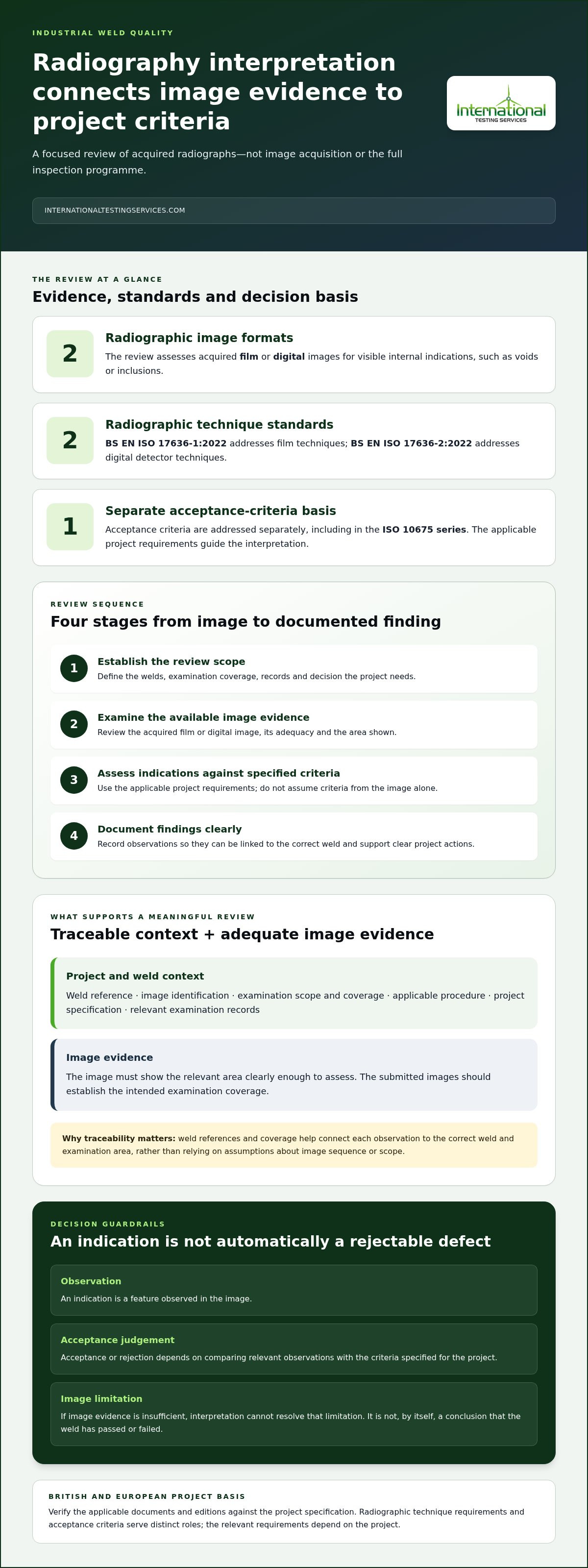
A useful interpretation follows a defined sequence: establish the review scope, examine the available image evidence, assess relevant indications against the specified criteria, and document the findings. Image evidence and agreed project criteria jointly inform an interpretation; neither provides a reliable basis for a decision on its own.
This process depends on traceable context. Each radiograph needs to be associated with the correct weld and examination area, while the applicable procedure and project documents establish what the reviewer is assessing. Without that link, an observation may be difficult to assign or evaluate consistently.
What information supports a meaningful interpretation?
Provide the information needed to connect each image to the work and its requirements. This may include the weld reference, image identification, examination scope, applicable procedure, project specification and relevant examination records. The specific materials depend on the agreed review scope. Clear references keep observations tied to the correct weld, rather than relying on assumptions about image sequence or coverage.
Image quality and examination coverage also affect how confidently the evidence can be assessed. If an image does not show the relevant area clearly, or the submitted images do not establish the intended coverage, the reviewer may be unable to reach a conclusive assessment from that evidence alone. This is a limitation of the available review material, not a finding that the weld has passed or failed.
How findings relate to acceptance criteria
An indication is an observation in the image. Acceptance or rejection is a judgement made by comparing relevant observations with the criteria that apply to the project. The two should not be conflated: identifying an indication does not, by itself, establish whether it is acceptable.
For British and European projects, verify the applicable documents and editions against the project specification. BS EN ISO 17636-1:2022 and BS EN ISO 17636-2:2022 address radiographic techniques for film and digital detectors; acceptance criteria are addressed separately, including in the ISO 10675 series where applicable. The relevant requirements depend on the project, so interpretation should use the specified criteria rather than a default or assumed threshold.
Where the acceptance basis is unclear, or the image evidence is insufficient for comparison, the conclusion should state that limitation rather than imply a definitive decision. The assessment must remain grounded in the project’s governing documents and the evidence available for review.
Radiography interpretation services are most effective when scope, evidence and assessment basis are aligned from the outset. For a project-specific image review, discuss radiographic interpretation in relation to the weld references and criteria governing the work.
Compare Radiography Interpretation Scope Against Your Project Needs
The interpretation scope must match the inspection question, available radiographic evidence and criteria governing the weld. Start by identifying the decision the project needs to make, then check whether the submitted images and project documents support it. This prevents a review of particular welds, images or requirements from being treated as general assurance of weld quality.
Use the comparison below to clarify what the review can establish. “Likely outcome” describes the kind of conclusion the evidence may support, not an automatic acceptance decision.
| Interpretation scope | Required evidence | Project criteria | Likely outcome |
|---|---|---|---|
| Review of identified weld radiographs | Images linked to weld references and the stated examination area | Applicable project specification and acceptance basis | Findings can be assessed against the defined requirements for the reviewed scope |
| Review where image coverage or identification is unclear | Available images and examination records, with gaps identified | Specified scope and relevant project documents | Assessment may be limited to the evidence that can be confidently associated with the weld |
| Review alongside other NDT results | Radiographs and relevant records from the specified methods | Project requirements for each examination and the overall decision | Results can be considered together where the project calls for coordinated evidence |
When is radiography interpretation the relevant service?
Radiography interpretation is relevant when radiographic images have been acquired and the project requires them to be reviewed for specified welds. Scope the request by identifying the weld references, the examination coverage represented and the decision the review is intended to inform. Then align it with the applicable project criteria. Radiography is not automatically preferable to ultrasonic inspection; method selection depends on project requirements and inspection purpose.
When might additional NDT evidence be relevant?
Additional evidence may be relevant where the project specifies more than one examination method, or where an inspection question calls for another form of assessment. PAUT or TOFD may be included when the project requirements define their role. They are not an automatic follow-up to radiographic interpretation, and one method’s result should not be treated as a substitute for another method’s specified evidence.
Interpretation alone does not guarantee acceptance. The reviewer assesses the available radiographic evidence against the applicable criteria; the final project decision depends on the defined requirements and the evidence needed to satisfy them. If radiographs do not cover the relevant scope, or the project requires other NDT results, a radiographic review by itself cannot establish those matters. Keep the method, evidence and acceptance basis connected in the review scope.
Prepare a Clear Scope for Radiography Interpretation Services
A defined review scope connects the images to the project decision they are intended to support. Before submitting material for interpretation, establish which welds are in scope, what question the review should address and which project requirements govern the assessment. Clear inputs reduce ambiguity, but they do not predetermine findings or guarantee acceptance.
Set the interpretation scope and acceptance basis
Start with the weld references and radiographic image set. Identify whether the review covers particular welds, a defined section of work or a specified examination area. State the purpose, such as assessing image indications against the acceptance criteria identified in the project documents. This defines the review’s boundaries and helps prevent conclusions from extending beyond the evidence supplied.
Provide the governing project specification and any applicable examination procedure or acceptance criteria. For British and European work, verify the required standards and editions against the project documentation rather than relying on a general reference. BS EN ISO 17636-1:2022 and BS EN ISO 17636-2:2022 concern film and digital radiographic techniques respectively; the applicable acceptance basis is separate and must be established for the project.
Organise image evidence and project records
Arrange images so each can be associated with the relevant weld reference and examination information. Include records or procedures where they form part of the agreed scope. A practical preparation sequence is:
- Define the purpose. State which welds or images are to be reviewed and what the interpretation must address.
- Identify the evidence. Connect each radiograph to its weld reference and the examination coverage it represents.
- Supply the assessment basis. Provide the applicable project specification, acceptance criteria and relevant examination records.
- Flag limitations. Identify missing context, uncertain references or areas where the submitted evidence may not cover the intended scope.
This sequence supports traceability between the image, the weld and the project requirement. It also helps distinguish an interpretation finding from a limitation in the material available for review. File formats and report fields should follow the project’s agreed arrangements.
For broader quality assurance, radiographic interpretation should sit within the project’s planned inspection process, alongside applicable procedures, records and other specified examinations. That context matters where the project uses multiple NDT methods or requires technical oversight beyond image review. International Testing Services Ltd provides separate Level 3 consultancy for procedure development and technical oversight when a project requires broader support.
Prepare a project-specific image review scope with International Testing Services Ltd, including the weld references, available radiographs and criteria relevant to the assessment.
How International Testing Services Ltd Supports Radiography Interpretation
International Testing Services Ltd provides radiography interpretation for industrial welds, reviewing radiographic films and digital images to assess weld quality and identify internal voids or inclusions. The review is based on the available image evidence and the project’s specified requirements. It is an interpretation service, not radiographic image acquisition, and its conclusions relate to the material and scope provided for review.
For project teams, this distinction sets a clear boundary: images are reviewed against the relevant weld references and acceptance basis, while the project’s wider inspection process determines how findings are used. A clear scope supports a focused assessment without implying that interpretation alone guarantees a weld’s acceptance.
Industrial image interpretation within the NDT portfolio
Radiography interpretation is one part of International Testing Services Ltd’s wider non-destructive testing portfolio. The company also provides phased array ultrasonic testing (PAUT), time of flight diffraction (TOFD) and ultrasonic inspection as distinct services. These methods are not automatically included in a radiographic review. Their relevance depends on the inspection question and project requirements.
Where a project calls for technical oversight beyond image interpretation, Level 3 consultancy is a separate related capability. It includes procedure development and technical oversight. Its role can be considered in relation to the project’s needs, rather than assumed as part of every interpretation request.
Define the project-specific next step
A well-scoped enquiry gives the review a practical starting point. Identify the welds or image set, provide the available radiographic films or digital images, and state the criteria or project documents that should guide the assessment. Include examination information that connects each image to the intended weld and scope. If the work also involves other NDT methods, distinguish those requirements from the radiography review.
This information defines what the interpretation is intended to address and what evidence is available. The service scope can then be aligned with project requirements without presuming an outcome before the images and criteria are assessed. Where requirements call for wider technical oversight, treat that need separately from the image review.
For a project-specific discussion, contact International Testing Services Ltd about radiography interpretation. Set out the weld scope, image evidence and applicable project criteria so the review can be considered in context.
Make the Next Weld Review Project-Specific
Before images are assessed, establish a clear decision path for the project. Align the intended scope with the weld references, available evidence and governing acceptance basis, and keep unresolved criteria visible rather than relying on assumptions. This gives project teams a defined starting point for applying radiography interpretation services to their quality assurance process.
Where broader technical oversight is needed, align that support separately with the project’s requirements. The priority is a review scope that reflects the work and supports a clear, traceable decision without presuming the outcome in advance.
Discuss your industrial radiography interpretation requirements with International Testing Services and take the next step towards a review aligned with your project. A clear scope helps keep the assessment focused and the resulting actions connected to the relevant requirements.
Frequently Asked Questions
Does radiography interpretation replace radiographic testing?
No. Radiographic testing produces examination images; interpretation reviews images that already exist. For example, assessing an identified weld image set is an image-review scope, while exposure and image production belong to the examination activity. International Testing Services Ltd interprets films and digital images. Identify the weld references and project criteria so the review remains distinct from image acquisition and the wider inspection programme.
Can industrial radiography interpretation services review both film and digital images?
Yes. International Testing Services Ltd interprets radiographic films and digital images. For either type, the review needs enough context to associate each image with the correct weld and intended examination area. Provide clear image identification and relevant criteria rather than assuming a particular submission system or file format. The usefulness of the review depends on the evidence provided and the requirements it must address.
Can radiography interpretation determine whether a weld is acceptable?
Interpretation can assess visible indications, but acceptance depends on the project’s specified criteria and the evidence available. An indication is an image observation, not automatically a rejection. The observation must be evaluated against the applicable acceptance basis before a decision is made. If the criteria are unclear or the images do not support an adequate assessment, the interpretation should state that limitation rather than promise a definitive acceptance outcome.
Which standards apply to industrial radiography interpretation in the UK and Europe?
The applicable standards depend on the project specification and governing documents. BS EN ISO 17636-1:2022 addresses film radiographic techniques, while BS EN ISO 17636-2:2022 addresses digital detector techniques. Acceptance criteria are covered separately, including by the ISO 10675 series where applicable. Check the relevant parts and editions against the contract and project requirements; these references should not be treated as universally applicable to every weld review.
What information should be provided for a radiographic interpretation review?
Provide enough information to define the review and connect the evidence to the work. This commonly includes the weld references or image set, the purpose of the assessment, and the applicable project specification and acceptance criteria. Relevant examination records or procedures can add context if they are within the agreed scope. The appropriate information depends on the project, so there is no universal submission format or document list.
What happens if a radiographic image does not provide enough evidence?
The interpretation may be limited if image quality, coverage, identification or project context is insufficient for the requested assessment. The appropriate next step depends on what is missing and what the project requires. It may involve clarifying the weld reference, supplying relevant records, providing additional evidence or defining a separate inspection action. Interpretation alone cannot resolve missing image evidence, and no single corrective approach applies to every case.
How does radiography interpretation differ from PAUT or TOFD?
Radiography interpretation assesses radiographic images, while phased array ultrasonic testing (PAUT) and time of flight diffraction (TOFD) are distinct ultrasonic inspection methods. They produce different examination evidence and are relevant according to the inspection question, component and project requirements. One method is not universally superior. If a project specifies multiple methods, assess each result within its defined scope rather than treating one method’s findings as a substitute for another’s.


