
Which NDT provider can support your Fife project with the right inspection method and evidence for its requirements? The answer depends on the component, material, access, inspection objective and applicable British and European standards. For NDT Fife projects, a clearly defined scope helps match the examination to the work instead of defaulting to a one-method-fits-all approach.
International Testing Services Ltd is based in Methil and provides on-site inspection support across the UK and internationally. Services include Phased Array Inspection, TOFD Inspection, Ultrasonic Inspection, Magnetic Particle Inspection, Liquid Penetrant Inspection, Visual Inspection, Welding Inspection, Positive Material Identification and Level 3 Consultancy. The team brings 100+ years of experience combined, supported by ISO 9001 certification and DNV-CP-0484 approval for NDT and Inspection Services.
This article explains how different methods address different inspection needs, what information helps define an effective scope, and how a local team can support work at your site. It also covers practical ways to align inspection planning with project specifications and relevant standards, so you can prepare for a focused discussion and tailored quotation.
Key Takeaways
- NDT Fife inspection planning starts with the component, its condition and the project’s quality requirements.
- Ultrasonic, magnetic particle, liquid penetrant and visual inspection address different needs. Choose a method according to the material, access and examination objective.
- Define the scope by recording the component, inspection location, project stage and applicable British or European specification.
- Discuss project timelines with the inspection team so the planned work can be agreed around site requirements.
- Use the steps in this article to identify relevant inspection support and prepare the information needed for a tailored quotation.
NDT in Fife: What local industrial inspection support covers
Non-destructive testing (NDT) examines materials or components without damaging them. It can provide evidence about condition, workmanship or material characteristics while the item remains available for its intended use or further project work. NDT Fife support helps project teams examine equipment and structures against defined quality objectives and applicable British and European standards.
Inspection requirements vary by project stage. Fabrication work may need examination of welds or verification of materials, while maintenance and shutdown work may call for inspection of existing assets. Integrity programmes use inspection findings to inform decisions about component condition and follow-up work. The component, inspection location, project stage and governing specification help define the method and extent of examination.
The following TWI video introduces the principles and application of NDT in engineering:
Fife’s renewables, oil and gas, maritime, civil, nuclear and petro-chemical sectors may all require inspection support, but the examination objective differs from project to project. A weld in fabrication, for example, raises different inspection questions from a component being assessed during maintenance. The range of non-destructive testing methods reflects these different needs. Method selection should follow the project specification and the characteristics of the item under inspection.
When Fife projects need non-destructive testing
Fabrication, planned maintenance, shutdowns and asset-integrity work each create distinct inspection requirements. A project team may need evidence to assess workmanship, examine a known area of concern or establish the condition of an asset. These objectives shape the scope: which components are included, where inspection takes place and how findings relate to the applicable specification.
International Testing Services Ltd is based at Unit D, Dock Rd, Methil, Fife, UK, providing a local point of contact for Scottish projects and on-site services across the UK and internationally. The Methil base supports engagement for work in Fife, while the inspection scope is tailored to each project and its requirements.
What a project-based NDT service involves
A project-based NDT service examines specified components or assets against agreed project requirements. It differs from training, which develops personnel knowledge, and personnel examinations, which assess individual competence. The inspection plan connects the component, examination method and specification, giving the resulting evidence a defined purpose.
For example, a project team can identify the item requiring examination, its location and the relevant project stage before establishing the applicable specification. The inspection provider can then align the examination with those requirements. Defining these elements helps avoid a generic scope that may not address the component or acceptance criteria in question.
To discuss a Fife project, contact International Testing Services Ltd at 01333 695 500 or [email protected]. Visit internationaltestingservices.com for further information.
NDT inspection methods available for Fife projects
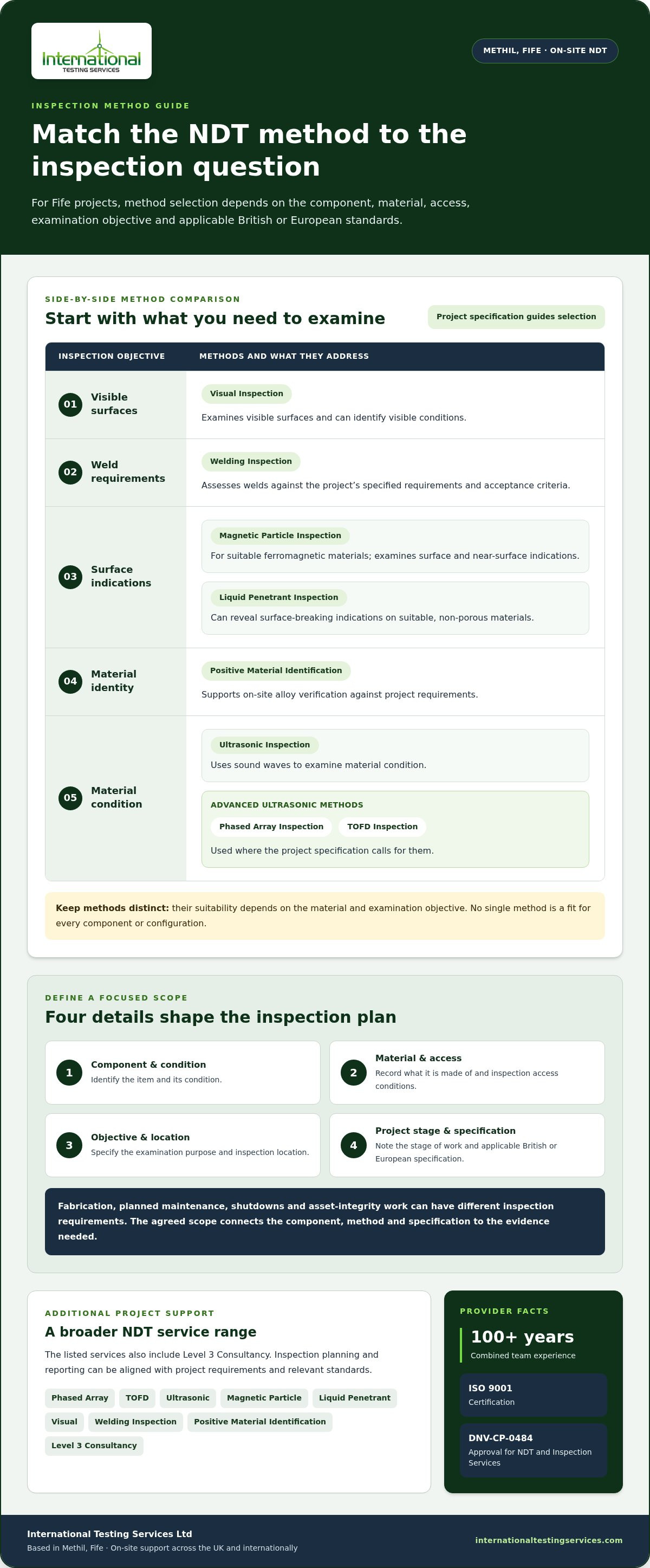
Inspection method selection depends on the component, material, access conditions and examination objective. A method suited to a surface assessment may not answer a question about internal condition. Start with the project specification and the evidence required, then consider the method against the item to be examined. The methods below serve different inspection needs across industrial projects in Fife.
British and European standards provide a framework for specifying inspection and reporting. The TWI guide to non-destructive testing offers further context on NDT principles and their engineering applications.
Surface, visual, and material inspection scope
Visual Inspection examines visible surfaces, while Welding Inspection assesses welds against the project’s specified requirements. They are distinct activities, although both can contribute to a wider inspection plan. Visual examination can identify visible conditions; welding inspection focuses on the weld and its acceptance criteria.
Magnetic Particle Inspection examines suitable ferromagnetic materials for surface and near-surface indications. Liquid Penetrant Inspection can reveal surface-breaking indications on suitable, non-porous materials. Material type and examination objective help determine which method is appropriate.
Positive Material Identification supports on-site alloy verification against project requirements. It can be useful where material identity needs to be checked during fabrication or asset work. These surface, weld and material examination services address different quality questions and should not be treated as interchangeable.
Volumetric inspection and specialist technical support
Ultrasonic Inspection uses sound waves to examine material condition. Phased Array Inspection and TOFD Inspection are advanced ultrasonic methods for projects where the specification calls for them. The component, examination objective and required evidence inform the choice; no method should be assumed to suit every configuration.
Project specifications may also refer to radiographic examination. Radiography Interpretation supports the interpretation of radiographic films and digital images to assess weld quality and identify internal voids or inclusions. The scope should identify the examination required and the evidence needed, with the relevant project requirements guiding how results are used.
Level 3 Consultancy provides specialist technical support, including procedure development, quality assurance and technical oversight. This can help align inspection activity with project requirements and applicable British and European standards, particularly where technical direction is needed alongside examination work.
For a Fife project, identify the component, material, inspection objective and relevant specification when discussing method selection. International Testing Services Ltd provides inspection and consultancy support across these needs. Discuss NDT inspection requirements in relation to your project scope.
How to define the right NDT scope for a Fife project
A clear inspection scope connects the project requirement to the component, location, timing, method and applicable specification. This gives the inspection team a defined basis for planning and helps ensure the resulting evidence addresses the project’s purpose. For NDT Fife projects, specialist input can help clarify the scope when the required method or extent of examination is uncertain.
Information to establish before inspection begins
Before inspection is planned, assemble the information that defines the work. Identify the component or weld, available material details and reason for examination. Include project documents and acceptance requirements, then clarify whether inspection is needed during fabrication, installation, maintenance or a shutdown. These details establish a practical basis for planning and discussion.
- Set out the requirement. Define what the inspection needs to assess, such as a specified component or weld, and the project question the examination is intended to answer.
- Identify the item and material. Record the component, relevant material information and any drawings or records that describe the area under examination.
- Pinpoint the inspection location. State whether the item is at a fabrication facility, installation site or operating asset. Include access or location details relevant to planning.
- Clarify the project stage. Specify whether the work relates to fabrication, installation, maintenance or a shutdown. This helps define when inspection can take place within the project.
- Provide the governing documents. Share the applicable project specification and acceptance requirements. The scope should reflect relevant British and European standards where these are specified for the work.
- Agree the examination scope. Align the inspection objective, component, location, method and required evidence before work proceeds.
Matching inspection scope to project requirements
Method selection depends on the inspection objective and the component’s characteristics, including its material and configuration. A surface examination and an assessment of internal material condition address different requirements. The specification and available component information guide the decision. Avoid choosing a method simply because it is familiar or has been used on another project.
International Testing Services Ltd’s portfolio provides a basis for discussing project-specific requirements across Visual Inspection, Welding Inspection, Ultrasonic Inspection, Magnetic Particle Inspection, Liquid Penetrant Inspection, Phased Array Inspection, TOFD Inspection and Positive Material Identification. Level 3 Consultancy can also support technical review and scope clarification. The services selected depend on the work defined by the project.
For broader context on industrial quality control and NDT, consult this IAEA resource. Project-specific decisions should remain anchored to the applicable British and European standards and the requirements set out for the work. If the supplied information leaves uncertainty, specialist input can help clarify the examination objective and define a scope that is clear to the project team.
Project timelines are discussed and agreed with the client as part of planning. The agreed schedule can reflect the inspection location, project stage and defined scope, rather than rely on a fixed duration that may not suit the work.
On-site NDT in Methil, Fife, and across Scotland
For project teams arranging inspection at an operating asset or fabrication site, the location of the work matters. International Testing Services Ltd is based in Methil, Fife, and provides on-site NDT across the UK and internationally. Scottish project teams have a local point of contact, with inspection support also available at sites beyond Fife.
On-site inspection can support project environments including renewables, oil and gas, maritime, civil, nuclear and petro-chemical work. The component, inspection objective and project specification shape the service scope. If a project refers to British and European standards, sharing the relevant specification helps align the inspection discussion with its requirements.
Local base and on-site service coverage
The company’s address is Unit D, Dock Rd, Methil, Fife, UK. Its on-site service coverage extends across the UK and internationally. Project timelines are discussed and agreed with the client, allowing planning to reflect the defined inspection scope and project circumstances rather than a fixed duration.
For a Fife project, explain whether the work is at a fabrication facility, an operating site or another project location. A renewables fabrication inspection, for example, may involve different components and requirements from maintenance inspection at a maritime or petro-chemical facility. These examples show why location and project context belong in the enquiry, rather than assuming one standard scope applies across sectors.
Preparing an inspection enquiry
A focused enquiry gives the inspection team a useful starting point for defining the work and preparing a tailored quotation. Share the information available about the project, including details still being established. In particular, provide:
- Project location: the site or facility where inspection is required.
- Component details: the item or weld, with relevant material information or drawings where available.
- Inspection objective: what the examination needs to assess or verify.
- Project documentation: the applicable specification and any stated acceptance requirements.
- Project stage: whether the work relates to fabrication, installation, maintenance or a shutdown.
These details help clarify the inspection requirement and support discussion of the appropriate method and scope. The team can then discuss the project timeline with you and agree it in relation to the work. Clear information supports practical planning without assuming the same schedule or examination method will suit every site.
Contact International Testing Services Ltd by phone on 01333 695 500 or email at [email protected]. Visit www.internationaltestingservices.com to submit an enquiry online. When discussing on-site NDT for your project, provide the location, component details, inspection objective and relevant specification.
International Testing Services for NDT projects in Fife
International Testing Services Ltd provides inspection support from its base in Methil, Fife, for projects across renewables, oil and gas, nuclear, maritime, civil and petro-chemical sectors. Its portfolio includes conventional and advanced inspection methods, welding and visual inspection, material identification and Level 3 Consultancy. For project teams, this range creates a route to discuss different inspection requirements with one Fife-based provider.
Inspection evidence should relate to the component, agreed scope and project requirements. International Testing Services Ltd supports this work with quality credentials and technical experience, while inspection planning remains focused on the applicable specification and relevant British and European standards. A project discussion can establish which services align with the work required.
Experience, approvals, and quality assurance
The inspection team brings 100+ years of experience combined. This figure describes combined experience, not the age of the company or its headcount. International Testing Services Ltd holds ISO 9001 certification and DNV-CP-0484 approval for NDT and Inspection Services.
The company also holds ISO 9712 certification and approvals from DNV, BV and ABS. These credentials sit alongside its inspection work and technical support. For project stakeholders, the key consideration is how the proposed examination scope corresponds to project documents, quality requirements and applicable standards. Level 3 Consultancy can provide technical input when procedure development, quality assurance or oversight forms part of the requirement.
NDT Fife projects can involve different materials, inspection locations and stages of work. A provider able to discuss multiple methods and consultancy support can keep the technical conversation connected to the project scope. Each inspection requirement remains specific to the asset and its specification, so the approach should reflect the actual work rather than assume a standard package.
Contact the Fife team about an inspection requirement
To request a tailored quotation, provide the project location, component or weld details, inspection objective and relevant specification. Include any project documents or acceptance requirements available. This gives the team a basis to discuss the required inspection scope and project timeline, which is agreed with the client.
International Testing Services Ltd is located at Unit D, Dock Rd, Methil, Fife, UK. Contact the team by telephone on 01333 695 500 or email [email protected]. Visit www.internationaltestingservices.com to submit an enquiry online. For inspection support in Fife, send your project requirements to the team to begin a scope discussion and request a tailored quotation.
Set your inspection plan in motion
A defined inspection requirement gives your project team a sound basis for planning the next stage of work. Bring together the component information, examination objective and applicable British or European specification, then shape a scope around the asset and project conditions. This keeps method selection and inspection evidence connected to the quality requirements that matter to your work.
For NDT Fife support, put those project details into a focused discussion with International Testing Services. Its Methil-based team can help progress an inspection enquiry into a tailored scope and quotation, with the project timeline discussed and agreed with you.
Contact International Testing Services to discuss your Fife inspection requirements and take the next step towards a clearly defined inspection plan.
Frequently Asked Questions
What does NDT mean in industrial inspection?
NDT means non-destructive testing: examining a material, component or weld without impairing its intended use. In industrial inspection, the purpose is to obtain evidence about a defined condition or characteristic, such as weld quality or material identity. The inspection method is selected for the examination objective and the item being assessed. NDT is not a single test, but a group of methods with different applications.
Can non-destructive testing identify every type of defect?
No single NDT method can identify every type of defect in every component. Detection depends on factors such as the material, the location and nature of the feature being examined, access, and the method and scope specified for the work. A project may therefore need specialist input to determine whether one method or a combination is suitable. Inspection findings apply to the agreed examination, not to unexamined areas or conditions.
How do British and European standards affect an NDT inspection?
Applicable British and European standards can provide the framework for specifying and performing an examination. Project documentation should identify the relevant standard and acceptance requirements where these apply. The inspection scope can then address those requirements and the component concerned. Standards do not make every method interchangeable, so consider the specified examination and the evidence it needs to produce together.
How quickly can NDT inspection results be delivered?
There is no fixed turnaround that applies to every inspection. Result timing depends on the project scope and is discussed and agreed with the client. For planning, identify reporting or decision points that affect the work, alongside the inspection location, project stage and documentation requirements. This helps establish a timeline suited to the project rather than relying on an assumed standard duration.
Does International Testing Services provide on-site NDT outside Fife?
Yes. International Testing Services provides on-site NDT across the UK and internationally, including support for projects elsewhere in Scotland. Location forms part of the enquiry because it helps define inspection arrangements and project scope. Share the site location, component details and inspection objective so the team can discuss the work in relation to the project requirements.
How can I request an NDT quotation in Fife?
To request an NDT Fife quotation, submit your project requirements using the online contact form or call International Testing Services. Include the site location, component or weld details, inspection objective and relevant specification or acceptance criteria. Available drawings or project documents can also help clarify the requested scope. The team will discuss the inspection requirement and provide a tailored quotation.
Is NDT training the same as NDT inspection?
No. NDT inspection examines a component or material against a defined project requirement. Training is a separate activity intended to develop a person’s knowledge or practical skills. Personnel examinations assess individual competence rather than the condition of an asset. For an inspection enquiry, specify the item, examination objective and applicable project documentation so the requested work is clearly distinguished from personnel development or assessment.


